 Key Problem & Opportunity
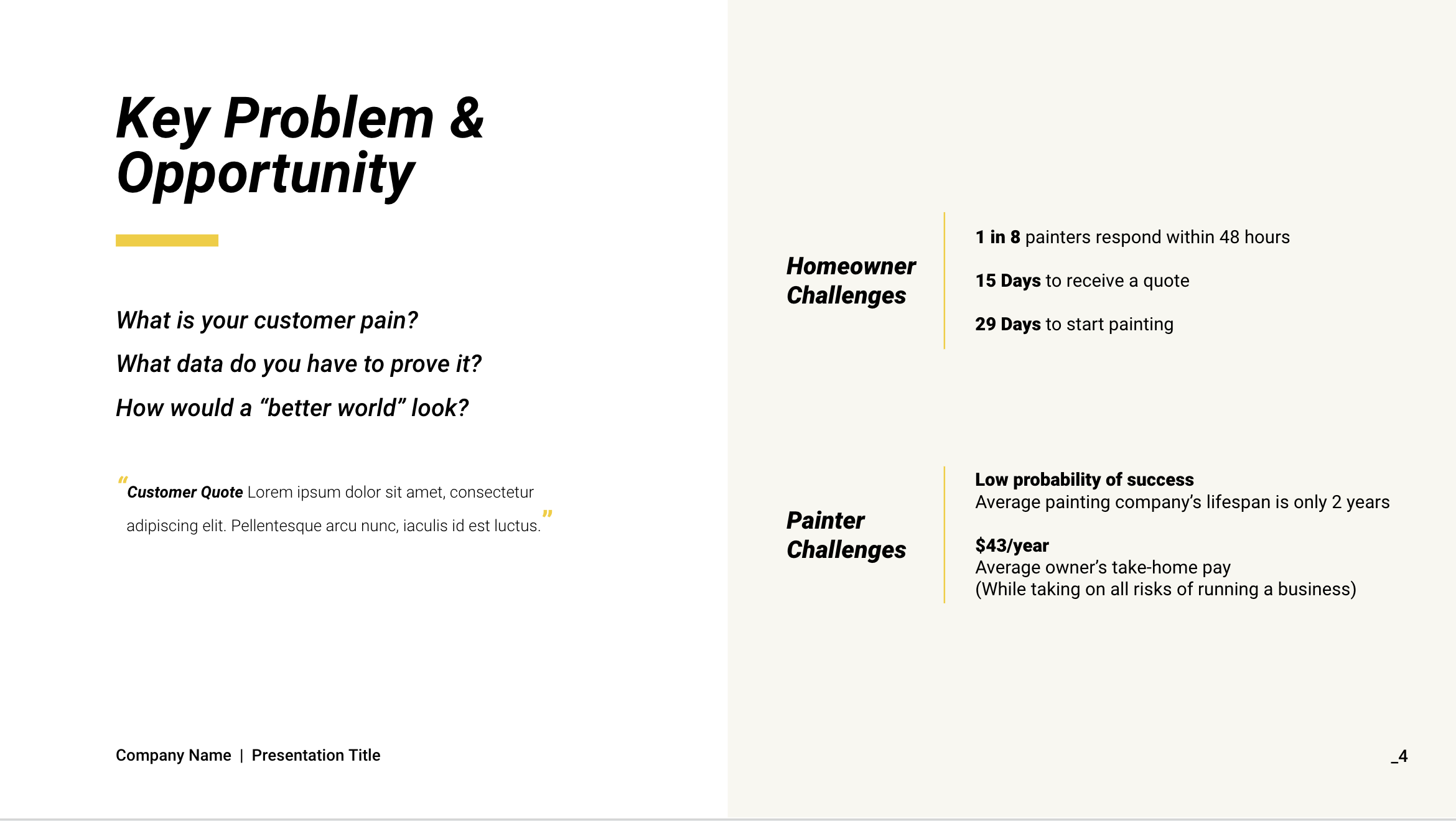
Clearly state the business pain that you’re going to tackle, connect that to a technology that can address the pain, and explain why customers will see this as an urgent need.
Refer to  DEFINE the Problem or Opportunity
Make sure your audience fully understands the significance of the opportunity before you move on. Ideally, they should literally be visualizing the unbearable nature of the pain. Or if they are representative of the target customer, they should confirm they are feeling the pain. Ideally, you want people dying to hear how you address the pain before you unveil your solution.
- Why is this an immense problem?
- What is the big opportunity here?
- What are the consequences of not solving it?
🎙 Hear how Michael taught it the lecture, cleaned & woven in
▶ Watch the original lecture
The next thing I’d do is get your audience understanding what problem it is that you solve.
To use my story as an example: one of the things everybody’s aware of is that the Great Wall got built as a defense. What you might not be aware of is some of the many other problems it also got used to address. It was used for border controls and for immigration. It was also used to collect duties along the Silk Road, and therefore either to discourage trade or to encourage trade. Now, you could say that problem could have been solved a lot more simply than building a five-and-a-half-thousand-mile wall that was built over many centuries. I believe it was seven centuries BC that the wall first started to get built in different pieces. The point is: whatever your story is, it should be as compelling as understanding, in this case, why did somebody build the Great Wall, and what was behind that. I’d encourage you to very quickly get focused on what that problem is you solve. And if you want to get into a bit more on positioning, you’d say “uniquely well for who,” which is our orientation again around what’s the market opportunity.
The specific thing we’re looking for behind the pitch: pain and need. When you start to talk about the problem you’re solving, there are two things we’re trying to understand. What is the business pain, and what is the need?
If you think about most business problems, they have elements of pain to them. For example, if you’re an enterprise trying to solve the problem of managing thousands and thousands of devices that people just walked into your company with and started accessing all your data with, it’s probably security at one level, but there may be many others. What’s the need? The need may be different. The need may be that you actually want your employees to have their devices connecting to the information that feeds things like your salesforce with the right price lists or the right documents to serve them in their day-to-day jobs.
So there are two different things there. One is a need: solving a business problem of giving people the right information to do their jobs. The other is a pain: if they don’t have the right security around that device, they may run afoul of regulations or run into compliance problems, for example in financial services. So very early on when you think about your problem, get into the definition of where is the pain and where is the need.
Why now? When you talk about pain and need, I also recommend you talk about what has changed. Why now? What is it that’s happened that has caused this new situation in the marketplace? For example, the move from the PC world to what people are calling the post-PC era, or the mobile device world, would be an example of a change. What might have enabled it is wireless or broadband access everywhere. In your case, whatever that may be, I encourage you to bring it out, because what we’re looking for is to understand: this might be a great idea, but is it relevant right now?