 DEFINE the Problem or Opportunity
 Whole Problem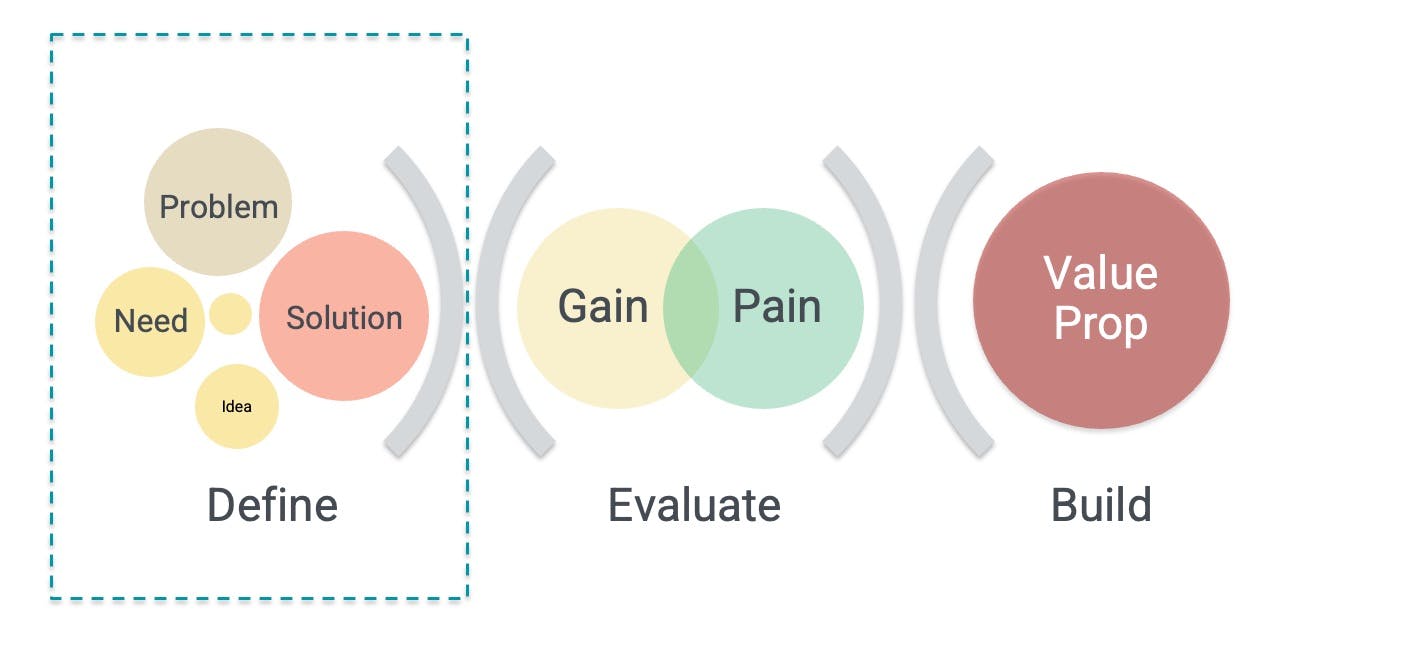
If you don’t know the problem you’re solving, any road will lead you nowhere. And if you don’t know who you’re solving it for, no one will be waiting for you. Ideas are worthless free floating distractions that can lead you to into the venture desert to die.
Yet, if you can listen and learn from the needs of potential customers and users where to apply them, they can become the wellsprings of innovation to solve a problem or open up an opportunity. Now, let’s help you define the problem you’re going to solve uniquely well for who, so your path becomes clear and you’re welcomed with open arms!
Defining the problem is the first step for a reason. It’s the most important step.
“If I had an hour to solve a problem I’d spend 55 minutes thinking about the problem and five minutes thinking about solutions.”
— Albert Einstein
It’s also the most overlooked step, as it seems obvious, yet the nuances of it are the things that later come back to haunt startups as they scale.
Click on the links below to review each framework to help you define your problem or opportunity:
- For who are you solving this problem? Define your
 MVS - Minimum Viable Segment
 - Is the problem you’re solving
 4U Unworkable, Unavoidable, Urgent, and Underserved?
 - Qualify and verify whether it really is
- Urgent, or just Latent and Aspirational vs Blatant and Critical.
- Underserved, is there a White space (space in the market for a new solution) or is there a lot of competition?
use the  BLAC and White framework to do this.
If you want to get some inspiration and understanding on both the mindset and approach to problem solving, read:
These articles will help you to discover how Amazon Web Services came about, learning from Andy Jassy, Amazon’s CEO and get further inspiration from  Elon Musk, Tesla, SpaceX
🎙 Hear how Michael taught it the lecture, cleaned & woven in
▶ Watch the original lecture
The first thing we define is FOR WHO. It sounds so obvious, but it’s where a huge number of startups go wrong.
Take Gulnaz’s nonprofit, Connected, which bridges the digital divide in Kazakhstan. When I pushed on the “who,” she got very specific: it’s children, from marginalized and rural communities, who don’t have basic digital literacy skills and who don’t have equipment. That’s a strong “for who.” Contrast that with a team that pitched a product to help “people dissatisfied with current credit products due to high interest rates get a better comparison marketplace.” Makes total sense, but they never said for who. That’s a massive problem, because if you don’t know who your customer is, you don’t know the persona you’re selling to or how to focus and target them.
Startup Secret: if you think your customer is “everybody,” you’re going to fail by default. Trying to boil the ocean and sell to the world at large is a giant undertaking. Even the largest companies in the world get very crisp about their target.
A great question came up: what if your user is different from your customer? Who do you put in the “for who”? The answer is both matter, but start with the user. The customer is the person who pays; the user is the person who benefits. If the user isn’t getting value, nobody will pay for it. You need pull from the user. But even when the user is not the payer (a government funding a nonprofit, or an IT gatekeeper in an enterprise), that payer still needs the user to convince them there’s a payoff worth investing in. So when the user and customer differ, you actually have to satisfy two value propositions: value to the funder, and value to the user, so you get both the money and the uptake. (Diagnostics for All is a stark case of this split: the patient in rural Ghana feels the pain, but a government or the Gates Foundation pays. We’ll return to that.)
Startup Secret: don’t pitch them anything, ask them everything. Everything you do should be looked at through your user’s eyes, not yours. All of you can do this without spending a single penny: go out and talk to them. If a user says “that’s not me, I don’t need that, that’s not a problem I have,” keep asking until you find the person who says “oh yeah, that’s exactly my problem,” and then keep asking until they say the pain is big enough that they’d actually engage with you.
Once you know who it’s for, define WHAT problem you’re going to solve for them. There’s a famous line I love: a problem well stated is half solved. If you can clearly identify the pain, need, or opportunity, it becomes easy to get your team to focus on what to build. But imagine the opposite: five engineers in a room who can’t even agree on what they’re building, or worse, who they’re building it for. That’s where a lot of startups die. You have to get crisp and say, “We are going to solve this particular hair-on-fire pain point, for these people, first.”