 Traction & Proof Points
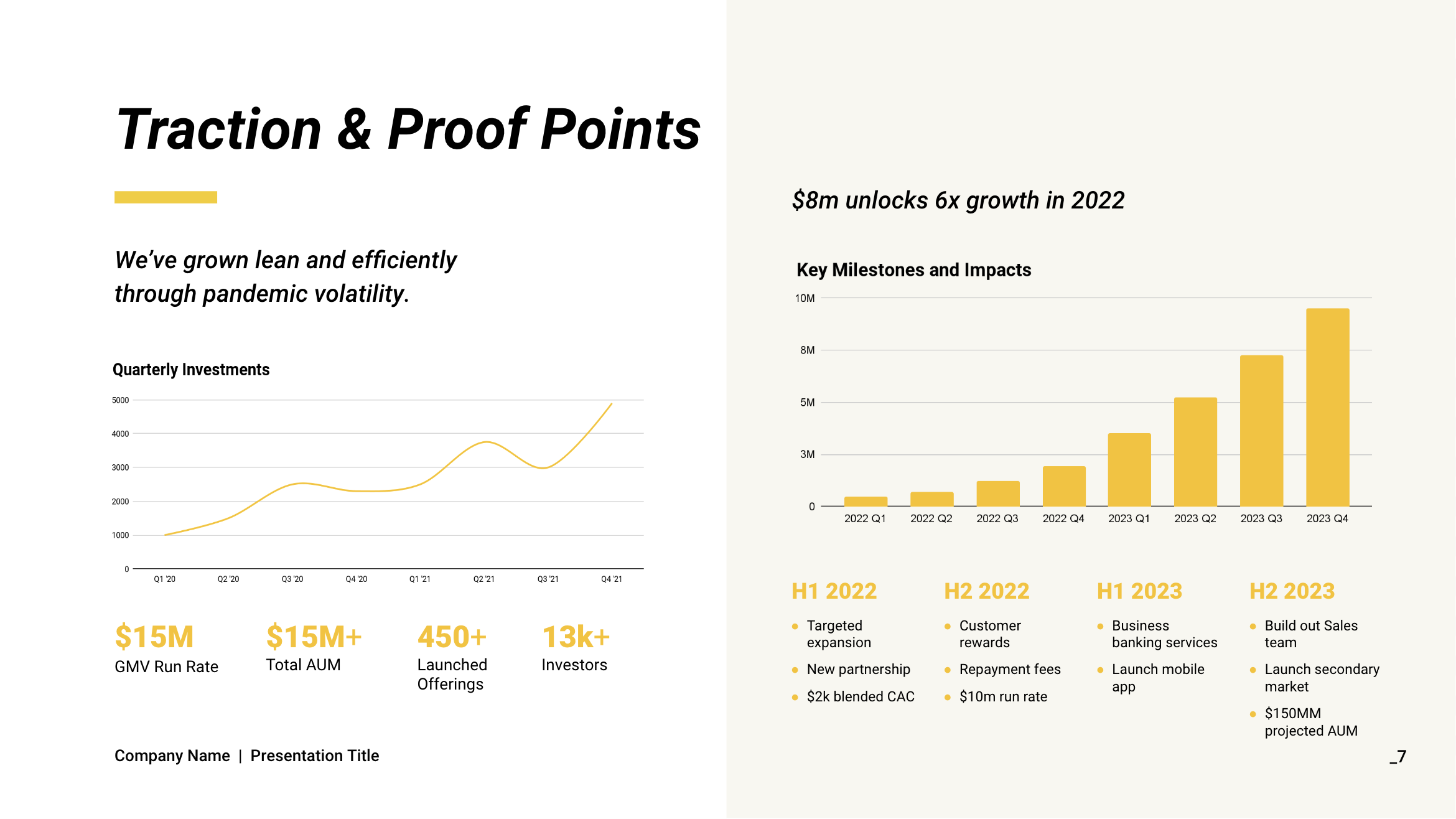
No matter what you claim, examples and case studies will prove that you can deliver. They are more credible than anything else you could say.
See the full milestone framework here . When targeting a Seed round, think about ways to prove that you’ve reached:
Market
- Problem/opportunity validation
- Conviction in $100M
Product
- Customer engagement
- Ease of adoption
- Roadmap to capture customer $
Go-to-Market
- Early indications of repeatability (prepayment, decreasing CAC)
🎙 Hear how Michael taught it the lecture, cleaned & woven in
▶ Watch the original lecture
Here’s the example I think we’ll carry on with in our case study tonight.
If you’re Cisco and you have tens of thousands of salespeople, and they suddenly come to you and say, “I’ve got my device, I brought it in, but I need my price lists and product lists, because we have hundreds of products,” and they can’t get them except by, and this is literally what they were doing, plugging iPhones into iTunes on everyone’s desktop and then sending everybody the documents via email, you have a problem. People aren’t at their desks by their iTunes plugging in their iPhone or iPad to get that information every day. They’re out on the road. That’s what salespeople do. So you’ve got a broken process. You’ve literally got no way to get the right information to your salespeople about the new products you’re launching and to keep them with the right prices.
So what did we do? We provided a mechanism that allows them to get that content essentially over the air, and to be able to update all those devices for each user automatically. What happened is they went from a very small number of people getting the content into the device to a much higher number of compliance. Thousands of people initially started with a small deployment, and then as the word spread, and as the salespeople actually started to see the value proposition for them, the solution got deployed across the board.
A simple case of the value proposition for them: a lot of their quotes are a very unique series of routers, switches, very special discounts, and so on. Getting that quote approved was something that would take them a week to do. Now they have a solution that allows them to do it on the spot from their mobile device as they are on the road, and get a quote approved much faster. So for the salespeople this becomes an enormous value proposition. They can be much more agile, and of course they see a lot of benefit in that.
So you go from acute pain, where you can’t even get the information out to them, where you’re reliant on people literally having their laptops and using iTunes to update their stuff, where the product managers launching the products are pulling their hair out because the salesforce isn’t empowered, to suddenly the salesforce not only getting the right information but actually being more effective, selling right in front of the customer in the moment, giving them quotes real time, and closing more business. It’s a joy. So, guess what: you go from a problem of a few hundred devices getting activated a month to tens of thousands getting activated within a matter of weeks.
So we’re looking for people to describe their value props in those before-and-after ways. When you can describe them in those acute ways, our interest also goes distinctly through the roof. But most people don’t spend enough time doing that. They don’t spend enough time getting this really, really clear. So I encourage you to do that.
Startup Secret: Bring proof. The best way to do it is what I just did with you. What have you done with your idea? What is the example you’ve got that you could articulate from a customer viewpoint? If you’ve got stories of what the customer’s done with your product, of how they’ve measured the return on investment or the payback period, how long it took them to actually get a return on investment, then bring them to the fore right at this point. Because we go from not really being sure whether this sounds real to having conviction around it, based on hearing, for example, a Cisco story.
The Cisco story that I love best is what they decided to name that process. They called it the Cisco Fridge. They put this app catalog and all the materials up in the Cisco Fridge online. So it became self-service in the end, for their salesforce to actually get access to all those applications.
Repeatable and scalable. When you’ve done that, you can articulate from your viewpoint how repeatable and how scalable it is. To call on the last of our guests for tonight: lots of players had alternative approaches to this. There were other players in the marketplace, they call them MDM players, but they were challenged to get this to scale, because from experience, having done the research beforehand, they were not able to do this via the cloud, so they were basically having to do it device by device. So what was the difference between our solution in terms of our business? How were we able to address this with greater scale, and how repeatable was it? Did it mean the entire company had to be focused on Cisco to get 10,000 devices out, or how did it scale?
Sim’s account: “It was designed so that we could scale, because it was a cloud-based service. It could be done with self-serve. An individual could get on board very easily. They didn’t need an IT person to set them up. They didn’t need to have a special certificate installed. They didn’t have to go through multiple steps. We sometimes said, well, salespeople are basically pretty simple people, they want it really easy. But everybody really wants an easy solution. If you give it a one-step process and you make people feel good about it, that’s part of the scalability. But there’s also an aspect that’s very social. They’ll tell their friends. This was actually a big part of it: the adoption was that they would show it to their colleagues, and they’d get excited about it. And ultimately, net promoter score: the folks at Cisco who have this, there are 10,000 of them or more, were showing it to their customers, and because of that we got leads and sales. So the aspect of scalability is the product design, but also thinking about the way in which human beings interact with technology. It’s probably one of the most critical things.”
Something Sim didn’t tell you, which is kudos to him and the team: when we first invested, it used to take about six or seven days for a customer to go from wanting to try the thing to going through the entire process, having to get an authentication with Apple and everything else to get it to work. How long does it take now? A minute. And that’s not an exaggeration. It became an opportunity for us as well as a problem: we were growing so fast that we had to reduce what was several days’ worth of process to get customers on board down to being able to do it within a minute. Originally the goal was “live in five,” so it’s great to hear it’s down to a minute.
The point is: when you’ve described how the customer is getting benefit, you should also get back to your business. What we’re looking to understand is that you’re thinking not just about the customer viewpoint, but also about how your business becomes repeatable and scalable.
If you’ve done this well, you’ll have credibility at this point. You can take a deep breath and say: okay, we know the problem you’re solving, we know the market opportunity, we understand how you’re doing it uniquely well, and we’ve got some proof that you’re doing it. So we’re paying attention.