 Business Model
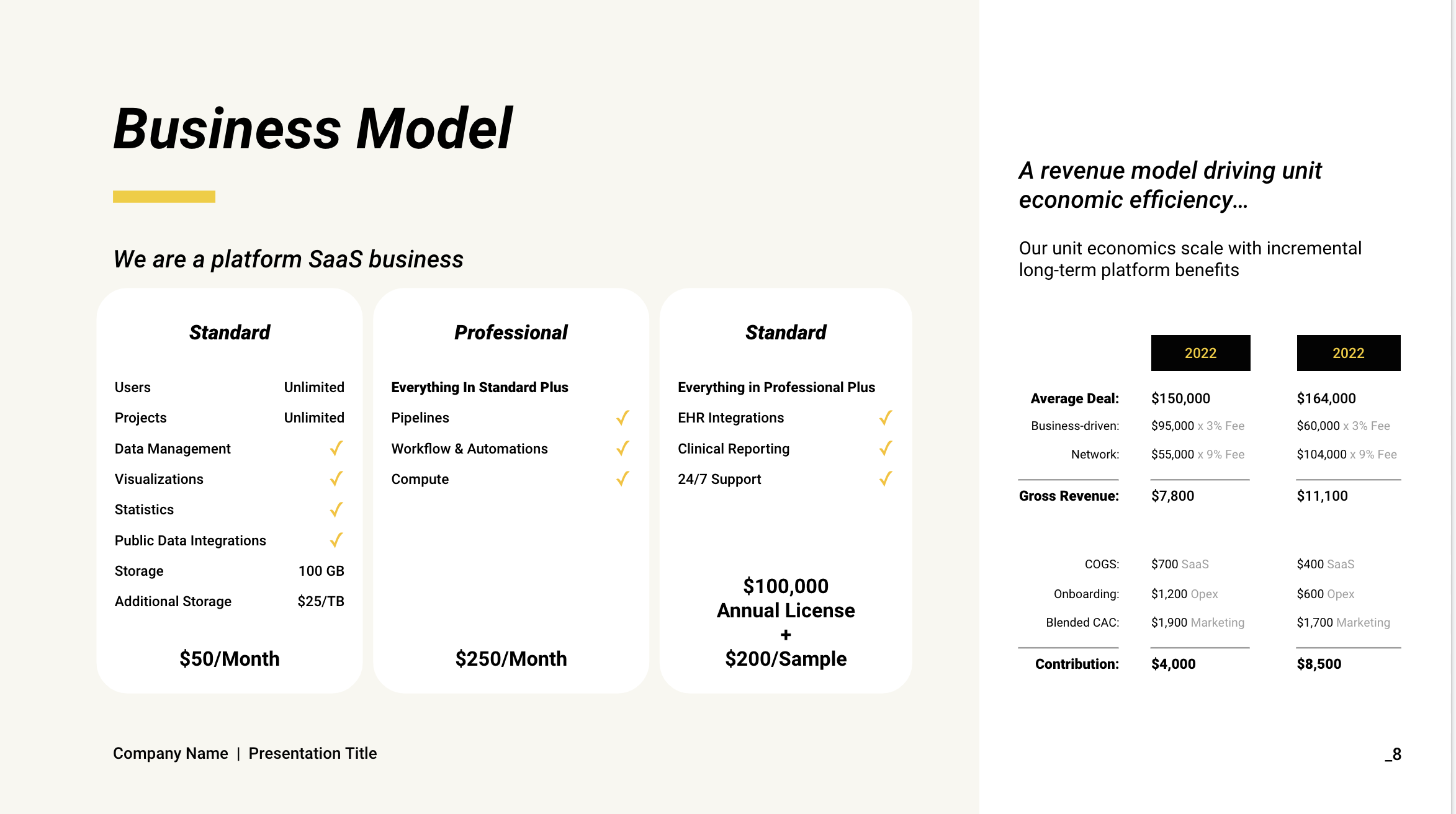
Your business model is also potentially a whole subject unto itself, but you should at least cover the basics of how you create, deliver, and capture value. See this workshop on creating a  Customer-Centric Business Model
This could include things like :
- Sample pricing, product packaging and delivery as part of your
 Go to Market
 - How you operate the business and can scale it to build and deliver your products and services predictably and eventually profitably.
In the end, investors need to know that you understand the methods and costs associated with building your product, selling it, and supporting customers in a repeatable, scalable, valuable, predictable, profitable and defensible (  RSVPD ) manner
🎙 Hear how Michael taught it the lecture, cleaned & woven in
▶ Watch the original lecture
On to business model. This section is really one thing: how do you make money? You may describe this any way you want, but I’m going to give you the three key things you should think about:
- How do you create your product? For example, do you get leverage out of things like open source or crowdsourcing?
- How do you deliver it? Is it just a salesforce delivery, or do you have, for example, a channel that can help you with delivery?
- How do you harness the value? This is things like what’s the basis on which you’re pricing, packaging, and delivering it.
Just to give you a sneak preview of the fun we have when we get to that workshop: there are so many exciting business models emerging. If I’d given this class 20 years ago, we’d probably have talked about a few very basic business models. But literally, business models are as innovative today as technology. You’ve got companies that have developed completely different approaches to the marketplace to deliver their value.
The classic example I like to talk about, and I’m a big proponent of open source, is Red Hat. Red Hat basically sells a product you can go and get for free. Linux is available totally free. So how on earth has a billion-dollar company, a billion dollars in revenue, by the way more like $8 billion in value, grown out of selling something free? We’ll talk about that when we do the business model class. It’s an important example of what I hope you’ll get from thinking about your business: new ways to build differentiation and to make it obvious how you make money.
Startup Secret: Align your revenue streams with your customers. One thing we’ll be looking for behind the scenes is whether this entrepreneur or team understands what to do to align their revenue streams with their customers and, for example, support partners.
What do I mean? If you have a fee-based system that says every time a customer does a transaction with you, they pay you a dollar, and if it goes up to 10,000 transactions a month maybe you take it down to 50 cents, that may be a great way to build your business. But wouldn’t it be better if you said, “I can actually give this away. We’ll give them all the infrastructure for all the transactions in the world, but every transaction they do, we’re going to collect the data on it.” So the customer is not paying anything for the entire infrastructure; we make money on selling the data about those transactions. That’s Nielsen’s business model. What I’d encourage you to do is not get stuck on a business model that is blatantly contradictory to what your customer would want. Charging them more as they use a service more is usually not what people want. They usually want to pay as little as they can upfront. What if you could give it to them free and find some alternate benefit that enabled you to make money off of them using it?
Align with partners too. Think about revenue streams that align with customers, and that also might support partners. How would you get other people involved in your supply chain to engage with you on working in your business? If they could make money from your product or from services around what you sell, they would definitely do that. Going back to Demandware: they’ve actually got 120 partners in what they call the Link program, all integrating with Demandware, which is an e-commerce platform, to give them things like customs-clearing services, tracking services, packaging services, or more importantly analytics services, advertising, personalization, and so on, all things people want around e-commerce that would be extremely painful for Demandware to go and build. By having those services integrated with their platform, all of those companies in that ecosystem benefit every time Demandware gets a new customer, and Demandware benefits because every time they’re looking for a new customer, they have a more complete solution. So we’re looking for you to define things, when thinking about your business model, that enable a business to get built around you, where partners can help you be more effective in getting to market and building your revenue stream.
Marketing and sales plan. If you can talk about it in your pitch and give instances of it, it’ll help us understand that you get the business: you’ve got your product, your service, your business model, and you understand why it’s unique. How do you actually get it out there? How do you get people buying it, and sell it effectively? The key thing I’d cover is a basic marketing and sales plan. A simple structure is to think about how you get awareness at the top all the way down to purchase at the bottom. This is a key part of what we cover in the go-to-market section. Some of the highlights you might cover: the segment, the particular target you’re going after, what the initial marketing and sales cycle is (whether you’d use inbound or outbound tactics), and in your sales plan, what you’d have as a salesforce. Would you have an inside sales force, or a combination with outside? Would you use direct or indirect? Would you use channels? Would you use services to sell your product, or would it be purely a product sale?
In general, we’re looking for you to have thought this through in enough detail that you’re thinking about how this will sync with your business model. How does it play to the way you’re pricing and packaging things?
Startup Secret: We’re looking for a customer lifetime value to acquisition cost ratio greater than 3x. If you cover this in your investor pitch, we’ll be netting it out this way: have these guys really got clarity about what it will cost to acquire and retain their customers, versus what they’re going to achieve in revenues from those customers over the lifecycle value of engaging with that customer? When you divide those two, we’re looking for a ratio greater than 3x. In other words, it costs you about a third as much as you’re going to gain from a customer over the time you’re going to address their needs. If you’ve got this metric well understood, and you can define what it takes to acquire a customer, the cost of acquiring them, how long you think you’ll serve them, and what you’ll get from them, you’re going to gain a lot of kudos from us, because at that point we know you have a viable business. You’ve got something that could actually be profitable. This business model will net out.
Being investors, we have to get to those numbers. I have to share a funny story now, because I’d been walking the wall for probably three or four hours, and I was told I’d get picked up by my guide about three or four miles down the wall, which doesn’t sound like a long way, but when you’re going up and down it’s a long way, especially carrying all the photo gear I was carrying. I discovered that the business model for the wall was actually pretty interesting. They don’t charge tourists to go there; it’s a huge tourist attraction. But if you ever want to buy a water, you’ll find the most unbelievable margins being made by all these sellers. The further you go along the wall, the price of the water goes up, as I discovered. And the later in the day it goes, the higher the price too. So I got lost. I missed my driver the first time, and I found the same seller coming back that I’d bought my bottle of water from, which was the equivalent of probably only about $3 or so, but that was a lot in Chinese terms. He was now selling it to me for $5. So I couldn’t help but say to him, “Wait a second. Same water, same guy, let’s have this discussion.” Of course I don’t speak Chinese, so I’m using my guide. Finally he says, “Well, it’s really simple. How many miles have you got to go back?” And I realized I basically have no choice. That’s basically where you want to be: in a place where it’s obvious your customers have no choice. You’ve got the price advantage and the business model that they’ve got to take.