 Fundraising Needs & Milestones
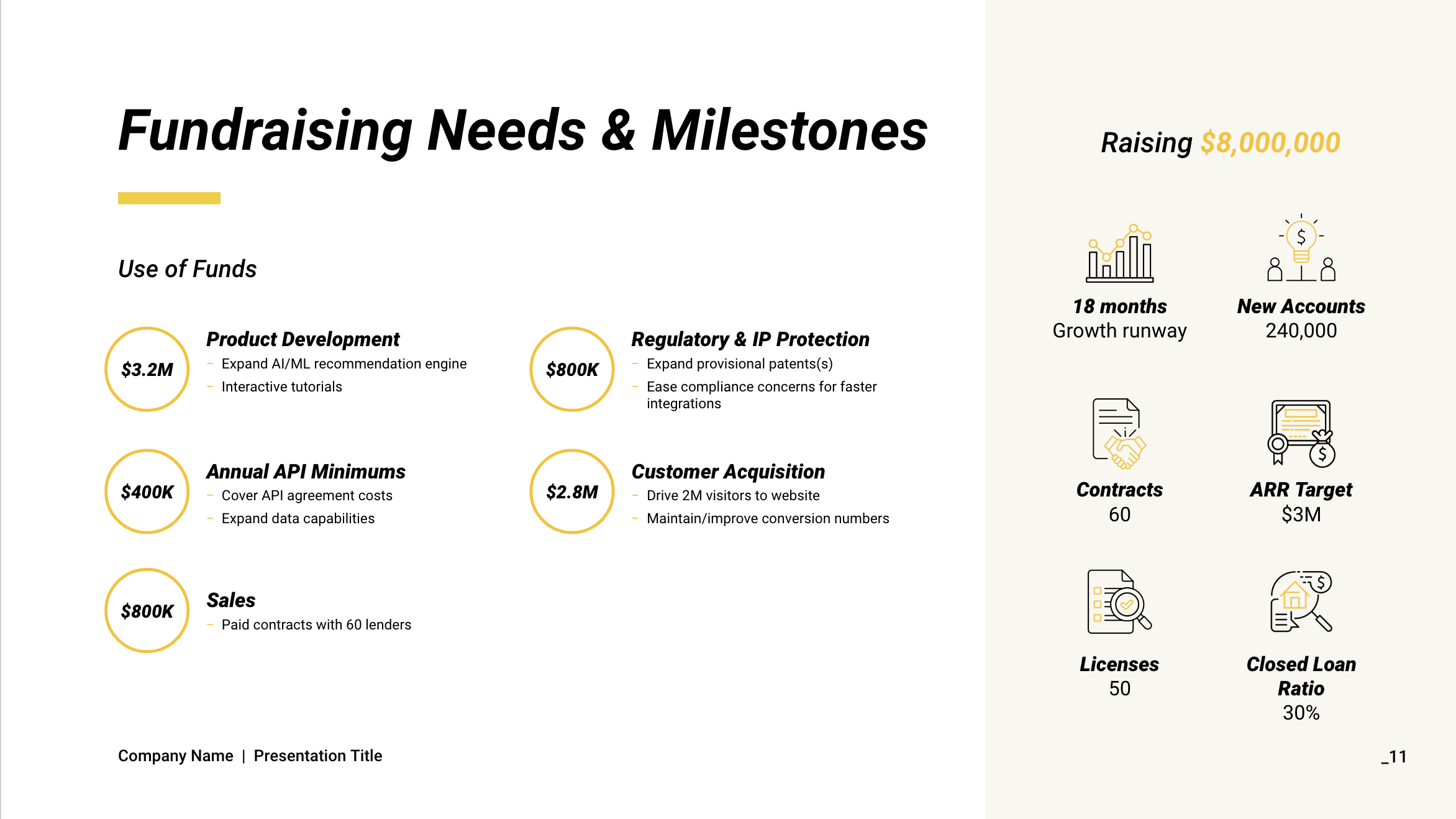
At Underscore, we typically finance about 18 months at a time because we’ve learned that’s long enough to allow the team to get focused on things like building and validating a product.
Determine how much you need to raise and test the assumptions you have about when you’ll need to raise money. This analysis requires figuring out what milestones you need to achieve in order to justify a higher valuation at each round of funding. See the full framework on financial planning and forecasting .
- Why do you need this specific amount of funding?
- What will you do with this funding? People, systems, processes
- What milestones will that enable you to achieve?
And on the bigger picture, sometimes very personal side of fundraising consider reading this Startup Secrets article  Funding Market Fit
🎙 Hear how Michael taught it the lecture, cleaned & woven in
▶ Watch the original lecture
When you start to get to the numbers, most people say go straight to financials. I say the exact opposite.
Startup Secret: The money falls out of the milestones and metrics. Don’t lead with the financials. What we’re looking for behind the scenes is that you understand the milestones and metrics that will drive the financials. We’re looking for things like: what do you think the key hires are, and when do you need to make them? When do you think you’ll get your product into beta? When will you get it to ship? When will you have your first customers? How long will it take to get those customers productive? That will lead to things like when you get to cash-flow positive or break even, which in many instances is a long time out. So the money will fall out of this: if you put the metrics together in the right way and can put those milestones out there, then you can build out the financials.
People always say, “What if I’m not a financial person?” Very few founders are both great at creating technology and great finance people. It’s our job to find resources to help you get these things in play. But at some point you will have to put a P&L and cash flow together, even if it’s with somebody who might be an interim CFO or a resource we found you. What you’re looking for is a basic breakdown, one year by quarter at a minimum, and then, this is the fun part, up to a five-year projection. We all know you’re not going to get that projection right, but it’s a help in providing guidance on how big the business can be. It’s the proof, if you like. It’s the challenge to say that this all foots together: if you’ve done all the right things we’ve just talked about, and you can project out against this huge market opportunity, you should have a big business. You should be able to show that’s the case over five years. That’s the goal of that projection. It’s not to be dead accurate; it’s about directionally being correct. Then there’s a series of metrics you can find on the site: not just revenue at the top line, but gross margin, expenses, footing it down to profit and loss, and cash.
Startup Secret: We’re looking for realistic optimists. But what are we looking for behind the scenes? This is one of my favorite things I try to help entrepreneurs with. We’re looking for a term I coined: realistic optimists.
What the hell is a realistic optimist? If you come in and say, “Our business is just going to go straight up and to the right, we think we’re going to go from 0 to $50 million in the first year,” you’re not realistic. You might be an optimist, but you’re not a realistic optimist. Why? Because if you go and look at the number of businesses that have gone from zero to $50 million in anything less than five years, it’s a very small number. Very small. Ever. We’re talking about a few companies like Compaq or Salesforce.com. I happen to have one in my portfolio, called Acquia, that just hit the Inc. 500 in the number eight position, and I’ve watched how hard it is for them to have gone from 0 to $50 million from scratch in our office in that period of time. It’s really hard.
You could be a pessimist and say, “Okay, well, it’s going to take me a really long time, ten years.” Trouble is, that’s a really long time for us to invest in, so we probably don’t want to hear that. Most of our fund lives are only ten years, so it’s going to cause us to think, well, they might be really accurate, but it’s probably not very exciting for us to invest in. So what we’re looking for is the realistic optimists: the people who can be honest with themselves about how long it’s going to take to get their business to a point where it really has momentum, and then ultimately become big.
In fact, if you look at the success of most of our companies, it usually takes much longer than they originally think, and then when it hits, it’s much bigger than they originally think. So what really comes across to us when we’re looking at the financials is not the numbers; it’s the thought behind it, and whether you are a realistic optimist. Whether you’ve actually thought out all the things it’s going to take to build a business that has the momentum to become big, over what time periods, and, more than anything else, what are the milestones behind that. So if you’re a realistic optimist, you’ve probably got my attention at this point.
I have a fun example of what was happening to me on the wall. As I said, I’d got lost and was having to go back to find my driver. I noticed that everybody else was headed in the opposite direction, which is never encouraging. But there was at least one guy who’d obviously given up, headed back in the same direction as me. The problem with this, to use the analogy in our world: if you’ve invested your entire life in building a business over several years, the last thing you’re going to want to do is give up. You’re probably going to want to see it through to get to the ultimate goal of whatever your mission or vision was.
Startup Secret: A stitch in time saves nine. The reason I encourage you to think about this: if you can, from day one, just put that extra bit of time into thinking about what it really takes to build your business, then the chances are that classic phrase, a stitch in time saves nine, will play out. What’s an example? Almost every business has many different paths it could take. You could say, day one, “I’m always going to sell direct, I really believe in this, it’s the only way it’s going to work.” Or you could say, “No, I’m always going to sell indirect right from the get-go.” The answer, in many instances, is that if you think through all those combinations and permutations, you’ll find out that your product doesn’t suit one or the other, or your proposition with your customer needs to be delivered either directly or indirectly because of the way it needs to be serviced or supported. There are so many different ways you could cut out all the twists and turns that can cost you so much and delay you so much. In my case, if I had just taken a GPS, it would have been very easy. God knows why I didn’t have the iPhone data plan in advance. Imagine how much trouble it would have saved me.
The equivalent in the startup world to that GPS, in my opinion, is to find the kinds of people who have either done it before, who can be part of your core team or advisory team, or find mentors, which is what the i-lab is all about, or find people who can give you the complement to your skill sets that will help you think out in advance the right way to build this business. Because although every business may be different, there are a lot of startup lessons people have learned that are very generic, around things like the business model and go to market.
Ask for the order. The last piece is you asking for the order: how much money do you want from us? It’s a simple thing. The cash raise should spell out what your use of proceeds will be, what you want the money for. Most VCs will have a rule of thumb about how long they’ll want to fund you for. We typically say 18 months. The reason is we don’t want you to have so much money that you just go out and blow it all right away, but we want you to have enough that you can make enough progress. And enough progress will be defined by those milestones. We tend to find that 18 months gives you enough time to, for example, build a product, go out and test it, get your first customers, validate that your business model is at least in its nascent forms workable, and then invest in whatever might be the next stage, which is making it repeatable or then scalable.
Startup Secret: Ask for exactly what your milestones need, not more, not less. Whatever your milestones are and whatever you need to raise money for, make sure that’s clear, and ask for that amount. Don’t ask for more, don’t ask for less, because you need to find yourself in a position where the next time you’re raising money, it’s very obvious that you met those milestones with the capital you raised. Therefore it’s not only appropriate to ask for more; hopefully the VCs will be saying, “Can I give you more?” because they’re impressed that you’ve executed.
The summary. That should then be the light at the end of the tunnel, in this case the sun coming up finally for me during the day. The summary should be as obvious as this: if you’ve done everything right, why is this a great investment? And how do you personally, or the team you’re with, have an unfair competitive advantage going after it? That should be around the things we talked about: you’ve had unique experience in this domain area, you’ve had the personal understanding of this problem, you’ve seen where this market’s going over some period of time, you’ve envisaged this opportunity, and you’ve developed this solution. Honestly, if you’ve done that behind the scenes, we’ll be sitting there dying to put money behind you. This should not be something you have to ask for.
If you don’t get the order, ask why not. Don’t forget, we’re putting money in; you’re investing your life. If you keep getting told no, that doesn’t mean it’s not a good idea. It turns out that some of the greatest businesses, like eBay, were turned down many, many times. But there also may be a reason people don’t invest, like you really didn’t complete the thinking around the whole product or solution, or where you’re going to take it to market, or the business model to make money around it. So take advantage of that. If somebody says no, ask them why. What was the issue? Don’t just let them get away with, “Well, we’ve heard this before,” or “There are three other pitches we’ve heard.” That may be true, but it’d be great if you could get real feedback.
Backup slides. This is all up on the web. Depending on the kind of presentation you have, there’ll be things like the cap table (who are the existing investors, how much have you given to the founders and team), and exit potential (beyond just an IPO, is there a potential acquirer you think is the way you’re going to go, and what would be some of the values that have been paid recently). Then, as needed for drill-down, there are things like financial assumptions, screenshots of your products, or customer testimonials, which you can always put in there. But remember what I said at the beginning: it’s very unlikely you’re going to put everything I just took you through all in one deck for one meeting. I just gave you the complete view of this, and you can pick off what you might need for various different people.
So you’ve been extremely patient. Your reward is I’m going to show you the few minutes of video I took, which puts all these photographs together for the walk. This is how, in the parable, I hope you’d end up: you’d end up with a bang, basically to say, hey, put this all together, and it all flows. Well, we’ve neatly wrapped up exactly on time. Thank you all very much. I’d be happy to spend some time with you individually too. I appreciate you taking the time this evening.