 Competitive Landscape
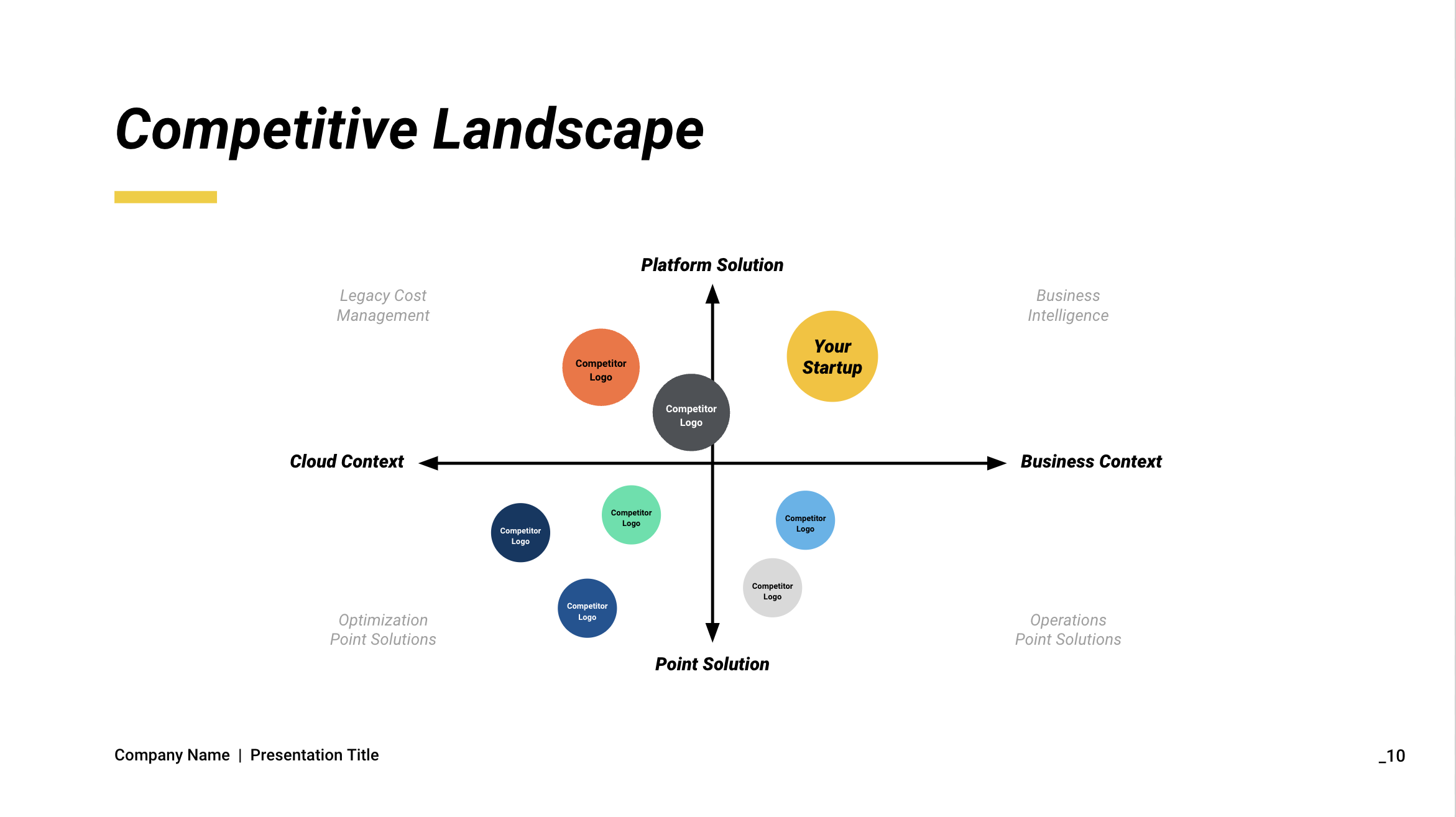
Key here is to use compelling axes to show a whitespace in the market. To avoid useless axes, think through:
- What aspect of your product is the stickiest?
- Can these competitors compete on this axis?
- Can this competitor cross this axis? What would that take?
- Why do your customers need this differentiator?
- What are you intentionally not?
- Are there other competitors in your quadrant? If so, how else are you different?
- Is your product better for a certain segment than another competitor?
For more information, see the full framework .
🎙 Hear how Michael taught it the lecture, cleaned & woven in
▶ Watch the original lecture
Now here comes the fun area: competition.
Startup Secret: “We don’t have any competition” almost always means you’re smoking something. Almost every entrepreneur makes the first mistake of saying, “We don’t have any competition.” Trust me, I hear that more than you can imagine. “No, this is brand new, it’s absolutely unique, nobody’s done this before.” It would be great, but it probably means you’re actually smoking something. One reason: there’s a finite number of dollars spent in any market area. Even if there is no solution to what you’re doing and it genuinely is brand new and unique, people only have a certain amount of money in their budget for whatever it is they’re doing. Even though the government keeps printing money in the healthcare example, the reality is there are still finite dollars in the healthcare system. So if we followed that critical-care example, even if you’ve got a completely breakthrough way of enabling critical care with this application, the reality is it’s going to compete with something else in the hospital. Your competition is whatever it is that would be competing for those dollars.
So I’d encourage you, right off the bat, to answer the question before we answer it for you: what’s your competition? Then get into things like, compared to the competition, our unique differentiation is the following.
Startup Secret: It’s never just technology. What else might come into your differentiation that’s not just the technology? Maybe your solution is better. But what if you’ve also got a distribution agreement with the carriers or the healthcare providers to actually get this solution to market, and everybody else in the marketplace hasn’t? Would that be an advantage? Of course it would. It’d be a major differentiation, especially if it was an exclusive agreement over some number of periods.
So think about not just the technology but, in case you don’t get to my class on business models, think about what your business model could be that’s differentiated. It turns out a differentiated business model is one of the most compelling things for us as VCs to see, not just the technology. And then, what might be the barriers to entry? Again, not just technology. We just talked about distribution, but there are many examples of barriers to entry.
Take the network effect. If you were Mark Zuckerberg and you started Facebook, you probably didn’t realize this in advance; maybe he was a genius and did. But the biggest barrier to entry for Facebook competitors is obviously the network. If you go on Facebook to share something, you know there are hundreds of millions of other people there. If you start the next Facebook, even if it’s ten times better, and you go on to share something as user number one, who are you sharing it with? Their barrier to entry is their network. You can create barriers to entry like that in almost any business if you start by thinking about it upfront. Again, I encourage you not to just get caught in the technology cycle and think it’s all technology.
Behind the pitch, we’re asking: why is this impenetrable, and why will it be sustainable? What is it that’s going to stop somebody coming along and just replicating this idea, or changing the approach and coming up with a different way to solve the same problem? There are obvious ways you can make things impenetrable. You can put patents around them. That’s tough for startups, though, because it’s tough for a startup to compete with a giant and have to go to court on IP. It certainly is important, but the more important thing is to think about things like the network effect, or go a bit further and ask what you’re building as you become successful. It might be something like data. Google in the end started as a search engine, but has a massive advantage today that would be tough to compete against: all the data it’s collecting about everybody every time anybody does a search. That data is a huge barrier to entry. They’ve probably got a bunch of other things too, for example the scale of their compute farm to be able to crunch that data. There are many things you can do to create these barriers in your business, and I’d encourage you to start from day one thinking about what you’re building up that will be difficult for somebody to assail.
Startup Secret: Use a 2-by-2 to claim your white space. When you present it, I recommend you use a picture. First, come up with something like a 2-by-2. If you haven’t been to business school yet, you will soon get used to the fact that everybody wants you to end up in the top right-hand corner. But before we get there, map everybody else out and size them, for example, on whatever axes you’re putting up. If it’s speed and price, which are typical things people put up, that’s fine, a good starting point. The size might represent the size of the companies.
But when thinking about what axes to put up, you want axes that are not just incremental in nature. Speed is an incremental example. Price is also incremental: people can always lower or increase their price. What we’re looking for are some real barriers that give you an opportunity to go claim a white space that somebody else can’t come after. What are examples of real barriers? One thing happening in the software world is a massive shift between everything being installed and stuff being available in the cloud. That’s a barrier, because it turns out that if you build applications for on-premise installation, they are totally differently architected than if you build them for the cloud, where they need to be what’s called multi-tenant, using shared resources to get the economies of scale the cloud provides. So that’s a classic example of a barrier: our competitors are on-premise, we’re in the cloud.
What you want to end up with is a clear white space where it’s obvious nobody else is building this. Using Apperian as an example: instead of the old tethered laptops or desktops, now mobile devices. That’s a distinct barrier: tethered versus mobile. Being able to define a white space that says “we’re the only people who can do cloud-based mobile deployment of applications to the enterprise” sets up a white space that’s going to be hard for others to come after, if you put all those other barriers in place. It also makes it very obvious that you’ve got unique positioning. In terms of your pitch, you should have something that is your positioning, that makes it obvious where your white space is, why you’re defensible, where your competitors lie, and how you’re out-positioning them.