 Team
Team
At the Seed stage, the number one, most important thing in an investment opportunity is the team.
At such an early stage, your product is likely to change, and your customer segment may shift, but one thing will remain constant: the founding team. Great founding teams navigate the ups and downs of entrepreneurship and work relentlessly to figure out how to build a company.
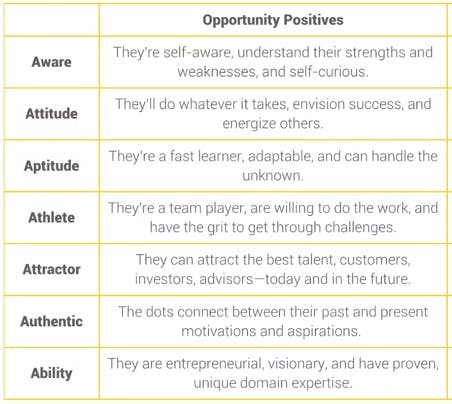
But as a founder, what does it mean to be a “great?” At Underscore VC, we look for seven key qualities.
7 “A”s of Great Founders
But what if you haven’t had that experience yet? If you’re not already a proven entrepreneur, explain the experiences that have led to your business insight and convinced you to invest your time and career in your new company. If you’re wondering what you’re uniquely qualified for, take some inspiration from this article:
And continue on your journey of  Personal Entrepreneurship
🎙 Hear how Michael taught it the lecture, cleaned & woven in
▶ Watch the original lecture
Now, with that agenda in mind, one of the first things I’d recommend is that if you’re going to give a pitch, before you even start, introduce yourself. It’s always all about people. Before you even get going on your pitch, go around the room. Try to understand who your audience is, where they’re coming from, and understand that what they’re trying to do is get to know you.
When we say that we invest in people, there are lots of forms in which we invest in people. Let me break down at least some of them that I suggest you cover.
Founders are a unique category. We’re lucky enough to have Chuck here as a founder, founder of a company called Apperian that we’re lucky enough to back. Chuck came out of Apple and started his company when he saw a need for the next generation of management of devices in this bring-your-own-device world. Chuck’s a unique guy. To have seen that long before even that term existed, before the iPhone had even taken off, before the iPad even existed, and before corporations really understood that Apple was a company they’d deal with, he was thinking about that. So we look for people like founders to give their insights as to how they came up with that idea.
Chuck’s own account: “I came up with the idea for Apperian because Apple was getting out of the custom development business. They could not build apps for enterprises anymore. We were doing it at Apple; they wanted to get out of the business. The world wasn’t ready. The Accentures, the IBMs weren’t ready to build apps or deploy apps. That created a real niche, and so I started Apperian to help Apple accelerate the adoption of iOS in the enterprise.”
What Chuck then did, which is an example of the kind of story I’d recommend you tell, is he parlayed that into realizing that if you generalize it, you’re going to need to not just produce custom apps, but in fact deliver thousands of more generalized apps, and you’re going to need to manage them. And that led to the entire business. So if you’re a founder, whatever your story is, tell it upfront. Make sure people understand where you’re coming from.
If you have management, and a lot of companies don’t in the very early stages, bring that into play. In the very early stages there is often no management team; there’s just a group of founders trying to figure out how to build themselves, and that’s great too. If you’ve got a board already, that’s terrific. If you’ve got advisers, that’s also great. Take those one step at a time.
The founders should always give a little bit of background on what led them to this opportunity, because that gives us the context to understand why they’ve got a particular advantage in the particular problem they’re trying to solve.
Startup Secret: It’s far less risk to back a bunch of people who have worked together. If you’ve got a group of people together, even if it was just from your dorm room, and you’ve worked together through some set of experiences, share it with us. Because it’s far less risk to back people who have worked together on something for some period of time, knocked off the edges, figured out what’s good and bad about each other, and learned how to complement each other’s strengths and weaknesses. That’s a big part of what it takes to build a company: to team around some problem and figure out what you can bring collectively rather than individually. So I’d encourage you very early on to make sure these things come out.
And if you do have management, talk about what previous companies they’ve been involved in, what achievements they’ve had, value that they’ve built, exits that they’ve done, and so on. That covers the team.
View the original page ↗ · note: 1 embed(s) were broken on the source site