 Funding Market Fit
Introducing Funding Market Fit. Now a critical concept for founders and entrepreneurs…
Background
Recently I read this tweet from a great entrepreneur Danielle Morrill.
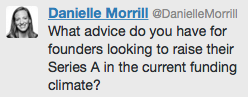
It was the straw that broke the camel’s back for me after months of gyrating markets and dozens of similar questions from founders. I was compelled to write. It’s not that Danielle’s question isn’t a great one. It’s just that upon reading the answers to this and other similar questions all over the web, it’s clear that populist answers are all over the map, often conflicting each other and mostly only reflecting a tiny piece of the much bigger picture.
For example:
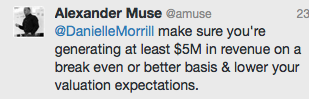
Again, not picking on this answer which may be perfectly reasonable, but generalizations like xx in revenue and breakeven are tough. And what has valuation got to do with it anyway? Yes, I know that’s provocative to entrepreneurs – it’s intentional :-0
Every business is different and key factors like the potential size and emergence of the market, your own readiness to address it and the like could make the tweet above absolutely right or completely wrong.
As per usual, I don’t have an answer, just a point of view with a framework for you to evaluate your decision making. If all you want is the Twitter version, here it is:
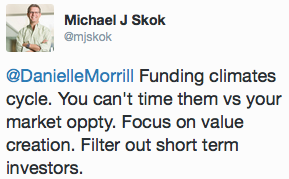
If you want more, here’s the thinking behind it.
Funding Market Fit
Funding Cycles vs Market Opportunity
You can’t control the funding climate you have to work with. So instead, focus on what you can control – the timing and amount of your cash raise and your spend to intercept the market you’re going after.
The key mandate as an entrepreneur is to track how the market itself is emerging and understand how your prospects and customers are responding to your offerings. Armed with that data, pace your go-to-market spend according to your customer acquisition metrics. Look at both how long and how much it takes to acquire and where possible expand customers. Don’t overspend if time and cost to acquire are not becoming more repeatable and declining. And never ignore churn. If you pace well, you’ll intercept the evolving need of the market with just the right amount of investment to capture an early leadership position.
Easier said than done and of course it still requires cash.
On the subject of how to much to raise, I’ve written about that for here . On the subject of timing your raise, as I recently wrote “cash has become king again”. So plan your funding to both raise in advance of when you’ll actually need the cash, but also in the context of key milestones you’ll need to show to raise again successfully. For example: show you’re meeting a real market need, prove repeatability with your product offering, and then think at least one round of funding ahead to what it will take to prove as many major milestones as will justify your next funding round. (At Underscore.VC, we call this Vector Funding™ – defining the Vector from where you are funding now to where you need to get to for the next raise). As you think about your vector to get funded again, get more specific than populist expressions like Minimum Viable Product (MVP) and Product Market Fit. Get granular and think of things like your  MVS - Minimum Viable Segment and show how you can show tangible progress, prove value, lead or even dominate in your tightly defined early market engagements.
Introducing Funding Market Fit
If you do this right and fund yourself at the right pace to capture your market leadership, then you have what I call Funding Market Fit.
Here’s Underscore.VC’s simple framework for Funding Market Fit.
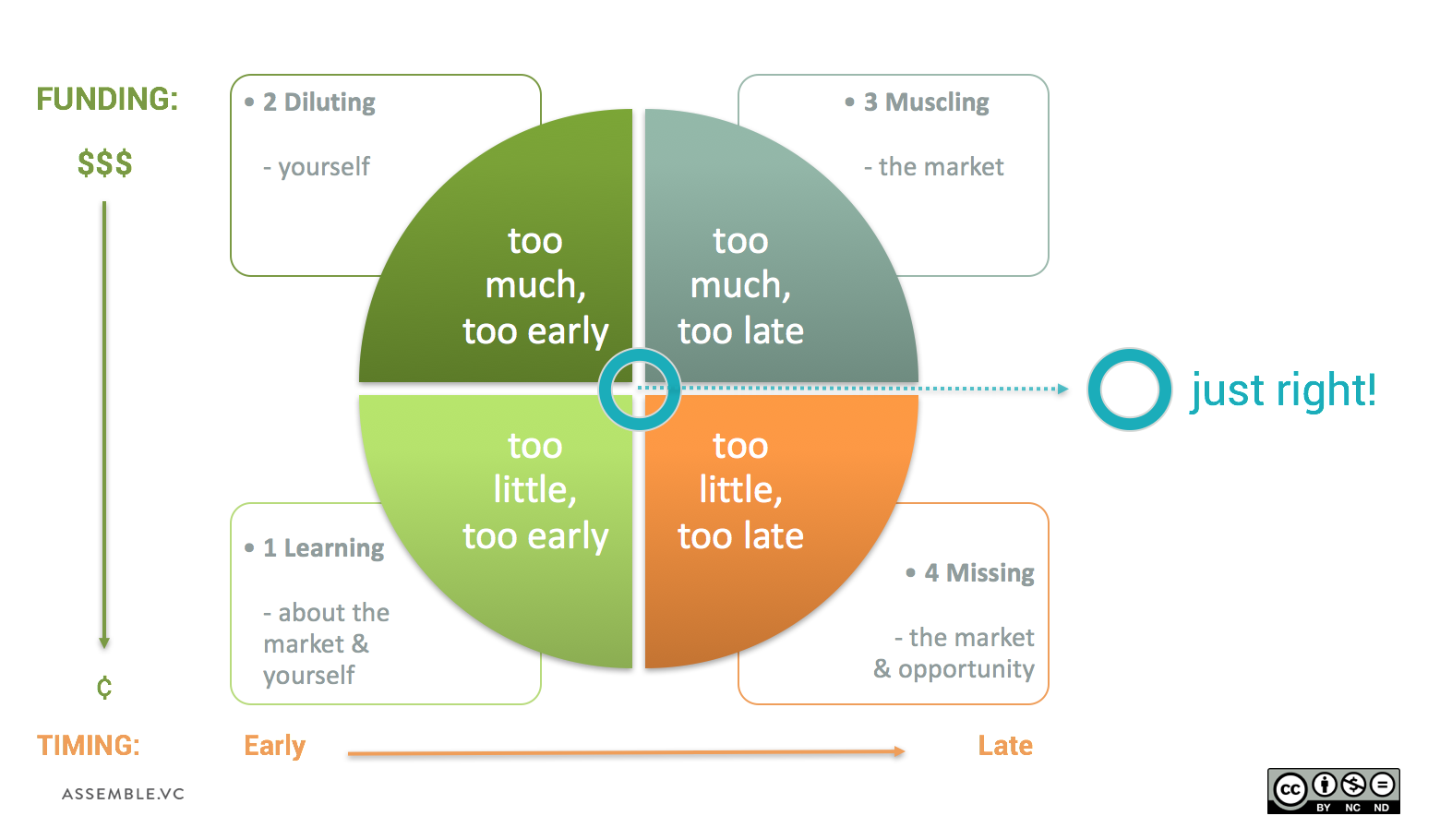
Figure 1: Intersecting the market – just right!
It’s tough to find the “goldilocks” just-right formula, and some of it is personal to your profile. In this case think about the four quadrants that may guide you as follows:
- Learning
- Probably better not to raise too much until you both understand product market fit and your own propensity for risk
- Diluting
- Raising too much too early can be good if you’re risk averse, but it requires real discipline not to overspend as you figure out the right way to pace your spend to the emergence of the market.
- Muscling
- Muscling your way into a market with more cash than anyone else can work, but it’s risky and expensive [click to tweet] . Some VCs even try to scare competitors off by choosing to use exclamative funding to aggressively possess a space. Again it can work but don’t bluff if you’ve not got the strong overall company-market-fit hand!
- Missing
- Too little, too late and you guessed it, you’re just going to miss the market opportunity 🙁
Think about how you can move from bottom left in the diagram to the center, by defining tight iterations of customer and market learning. Like most things in the startup world it will be an iterative learning process that also includes and is specific to you, your team, value proposition, go to market, and you business model. Don’t try to prove too much in each step. Reduce execution variables. Then recognize:
You can execute flawlessly but if the market isn’t evolving, pace it, don’t force it or overfund it.
Funding Market Fit will give you the ability to not only capture a market and lead it, but do so in a capital efficient manner. It’s not easy so let’s review a couple of scenarios at each extreme, so you can think about how to target your Funding Market Fit (FMF).
Oh dear, did I just give you another TLA?! Ignore the Three Letter Acronym if you like but please don’t ignore the concept, it will be at your peril.
If you are too early, you’ll burn cash trying to turn a latent aspirational need into a blatant critical need and that’s expensive. (See  BLAC and White and BLAC and White moves ) Worse still as the market pioneer with arrows in your back, you may well get run over by a better funded competitor who comes in later than you and can ride the trail you’ve blazed more cash efficiently, capturing the pull of the market as it comes to life.
Then of course if you’re too late, well, you’re too late! And of course, someone else will have captured the market ahead of you and begun building the customer relationships that you’ll have to win back in order to gain market share.
And even if you then “Muscle” your way into the market late, with a big fund raise, you’ll probably have to play by the early market leader’s rules, have to contend with disappointed customers on rebound sales cycles or worse still replacement sales, which are often even harder and more expensive.
Sometimes it may appear too late to enter an existing market but if you’ve got a breakthrough value proposition or disruptive business model such as Google had vs. incumbent search engines, that can be a fine way to blaze along the trail of already defined need laid by early market entrants.
Think 60-30-10. Leaders get to play for 60% of the market, Fast followers fight for the the 30% and the rest just fight over the scrappy 10% that’s left. Then think of the ratios between these. The leaders are often twice as valuable as the followers and 6x as valuable as the laggards who rarely survive anyway.
Talking of valuations, I’ve skipped the other top reason why trying to time your funding to optimize valuation rather than Funding Market Fit is just plain foolhardy. Maybe you tell yourself you can co-exist or settle for a fast follower position? It could be your only choice at that point, but lest you forget it, market leaders gain a disproportionately high valuation compared to their followers. They get the higher valuation for many good reasons. Their marginal cost of customer acquisition is often lower, they have a larger installed base to offer upgrades and new products to, and are therefore more attractive for partners to work with. I could go on. But the point is all of this feeds a virtuous cycle that is self reinforcing of their market leadership and makes it much more difficult to unseat them in the market ecosystem.

So when you put all that together, it doesn’t make sense to try to optimize the timing of your financing according to the timing of macroeconomic conditions and relative cost of capital. You can’t control those cycles anyway, the best you can do is simply acknowledge them and work with them.
The second key reason that timing your funding according to Valuation is just foolhardy is that it’s not just about the “entry” valuation, it’s just as much if not more about your “exit” valuation. And of course exit valuations are driven by timing themselves. To some extent you might be able to time your exit or IPO, but not always, as IPO windows come and go in macroeconomic cycles and if you’re going to be acquired or worse still have to sell, it may be out of your control.
So how impactful can exit timing be? Well you only have to look at the last year to realize how dramatically valuations can fluctuate. For example, In the public market, many SaaS companies are trading at a fraction of prior quarter multiples and nd they are way off their peak multiples - in some cases by nearly an order of magnitude. And some are even trading below historic norms.
All this is to say trying to time your funding to optimize valuation is crazy making stuff. Even if you can do it on “entry” realize you’ll also have to do it on “exit”. And in between is the real determinant of value – whether you can find a large market and capture leadership in it. That’s why Funding Market Fit is such a powerful and critical concept for founders to grasp.
Those of us who’ve watched the movie over and over again know the plot and the main characters to look for . Ensure you manage what is in your control and raise the capital you need to capture your market window and market leadership and pace your investing / execution accordingly.
If you do that right, even if you took more dilution because you had to raise money in a tough financing environment and owned less of your business early on, the ultimate value of your business has the potential to way more than compensate.
Bottom line:
Great entrepreneurs don’t over optimize valuation. They prioritize value creation through market leadership. Great investors don’t optimize short term financings, they prioritize large outcomes. And finally great partnerships between entrepreneurs and investors are formed when we get in sync on what matters for the long term.
As always we welcome your comments and look forward to hearing what matters most to you.
Source:
1. Capital IQ and IBES
- Note: Large Cap includes: Salesforce.com, Workday, Palo Alto Networks and ServiceNow. Small-to-Mid Cap includes: Demandware, FireEye, Marketo, Veeva, Tableau, Splunk and NetSuite. Multiples for FireEye and Veeva shown after estimates became available post-IPO. IPOs for these companies priced on 9/20/2013 and 10/16/2013, respectively. Revenue estimates per IBES. Estimates were calendarized for companies with non-December fiscal year ends. Enterprise values based on diluted shares outstanding. For table at upper right, 1 year forward multiple defined as current calendar year if before May, otherwise following calendar year metric utilized. Current multiples as of 7-Mar-2016.
This article originally appeared on Michael’s Linked in
Founding Partner at Underscore VC, Executive Fellow at Harvard Business School 60 articles
March 18, 2016
🎙 Hear how Michael taught it the lecture, cleaned & woven in
▶ Watch the original lecture
Let me run quickly through each of the types of funding I put up as sources, and then get to how you decide what’s right for you.
Angel funding
Angel funding takes a wide variety of forms. It’s usually a few thousand to a few million dollars, typically from individuals, and as Maya shares, it can be through networks.
I asked Maya what’s the benefit of having an angel network. Her answer: just like any asset class, angel investing has evolved because the marketplace has become more and more competitive. CommonAngels is not the only one; there’s a group on the west coast called Tech Coast Angels that also evolved from individuals making investments, to a group making investments, and then to a fund. The main reason is that the entrepreneur has the perception that angel capital can be challenging, and there are real examples where that’s true. But the benefit for the entrepreneur at the very early stage is getting an angel with the domain expertise for the company you’re developing. If you find the right person to help you think through channels, distribution, product design, or the real problem you’re trying to solve, the right angel investor can propel you and shortcut many mistakes. As Maya put it: choose wisely. Any source of capital, whether venture, angel, or seed, is a two-way interview. You are doing just as much interviewing as they are of you; you want to find the right partner to help you grow your business.
The benefit of an angel like Maya, or a network like CommonAngels, is that they understand it’s important to structure things right from day one, so you don’t end up with crazy term sheets and instruments that are very difficult for a Series A investor to follow on with. I’m lucky enough to have backed companies that came on from CommonAngels, and that’s one of the big benefits of having an angel network work with you.
Seed funding
There are two forms of seed in my book, and it’s pretty binary. The first form is spray-and-pray: people putting out so much capital there’s no chance of them taking the time and energy to help you get real value beyond just the money. Honestly, money is not your biggest challenge. It may feel like the thing you need most, but as soon as the first capital flows in, a thousand questions come up, and that’s when it’s really important to have somebody who will spend time with you, mentor you, and help you develop the next stage of your business and how you’ll fund it.
The second category is what I’d describe as the seed-to-A investors, who say, “We’d love to do your Series A, but there are a few things you need to prove and validate up front, and if you do, we’ll be there to follow on.” That may not happen for all sorts of reasons, but at least start out with the right expectation. Clarify right up front whether, if you meet the milestones, someone is already committing to do your Series A.
Jeffrey Beer from Seed to A added: there’s a decision you need to make as an entrepreneur. Are you trying to build a company that’s going to require twenty to thirty to fifty million dollars in capital, which takes you down the venture path? A lot of businesses don’t warrant raising that much. You may be building something you today only see as, say, a ten-million-dollar business, not a billion-dollar business. Or you may not know. So think differently: am I raising seed to get through Series A, which is one path, or am I raising seed to prove a certain set of metrics that give me the flexibility later to decide whether I take the venture path or finance my business differently? The way to do that is to think about it like agile engineering: get your proof points early, reduce risk and increase value early. If you can raise a small amount of angel or seed to answer those questions, you get further down the road so you can decide, “Do I take the express train to the venture path, or do I have an interesting business here that only raises three to five million but exits at a hundred to three hundred million?” That’s a very nice investment if you can find one, but it’s not necessarily interesting to the venture community, and you want to know that up front.
The railroad-track image matters: if you get off track, it’s hard to come back with investors. Above all, I encourage you to specify the problem. What we’re looking for is that you’ve been thoughtful enough to have validated that this is a business worth investing in, and for you that means your life. Never mind the amount you’re going to raise; ask yourself, do you want to invest the next several years of your life in this, even if somebody’s willing to write you a check? On average it takes six to eight years for companies to build serious value, go public, or get acquired. Even if there’s plenty of capital out there, ask yourself: are you ready to go the distance?
Accelerators
Reed from TechStars shared how accelerators help. Speaking only from his own experience with accelerators that have a business model as investors: at the early stage there are only four hats you can wear, founder, vendor, investor, or donor, and if you follow the money you can tell the difference. TechStars is very much a miniature version of a venture capital business. They have investors, they invest in the companies that join, and they can only survive if you succeed and they can pay back their investors, so they’re extremely aligned with your success.
From the outside it’s hard to see what you get: an eighteen-thousand-dollar check for six percent of your company in a three-month program. But there’s a lot behind the scenes: a couple hundred mentors and a community that bands together to support you. The results: Reed and his business partner Katie Rae took on TechStars Boston, and in two years they ran a two-million-dollar fund, with only a couple hundred thousand actually directly invested in each program, and invested in fifty-two companies. You have less than a two percent chance of getting in if you apply. Looking at their oldest cohort, 2011: they invested about half a million, and a hundred times that capital has been invested after them; two of the twelve companies hit breakeven and some raised up to thirteen million from brand-name investors. It’s a wonderful way for first-time entrepreneurs or people switching domains. They had an HBS grad who had built a successful venture-backed business raising twenty million; he applied because his next company was his first consumer-facing one, and at the end he said, “I learned in TechStars what I thought I’d learn at HBS.” With fifty-two companies and maybe three hundred investors, the companies tell stories about the investors just as investors tell stories about you: what’s this particular partner or angel really like to work with? It’s a great family to join if you can get in. It’s a concentrated way to get a bunch of facets of your business tested early.
Non-equity funding: strategic partnering, government support, philanthropy
There’s a whole raft of ways to get capital that is not equity-dilutive, and in some cases may be off balance sheet: strategic partnering, government support, and, particularly for not-for-profits, philanthropy.
Carmichael Roberts’s advice for building a not-for-profit: funding for any of these is not easy, but instead of a broad-stroke shotgun approach of meeting a lot of people hoping someone donates, identify at least one really credible, passionate person willing to be a philanthropist and back you, and then help explain to others why they backed you. Find one incredibly credible person willing to put some money in, and more importantly put time in, shoulder to shoulder, to help you.
I’ve been astounded at how creative the finding and use of finance has been in Carmichael’s companies, doing everything from next-generation solar panels to, in one instance, a stent that is stretchable as rubber, strong as steel, and dissolves in the body. No matter what your venture is, there are creative ways to go about this, and I encourage you to explore them rather than thinking everything has to be venture funded.
Strategic corporate investing
A special class of funding that comes up often, usually from companies with some track record: strategic or corporate investing. Think of VMware deciding to invest in you, or Intel, which has one of the largest programs out there. Should you take that money? I’ll boil it down to two things: what’s in it for you, and are your priorities aligned with theirs? What I see most is that the corporate investor’s agenda is simple: they’re finding a way to hedge that a startup might come up with a better idea than something they’re doing internally, and it’s great free R&D for them. That is not your agenda. Your agenda is building your business and getting somebody with a bigger brand to give you credibility, help you get to market, and accelerate your path. If those things are not aligned, do not take the investor.
That said, it can be company-making to get an investor who brings the brand that enables you to get to market. But startup secret: get the deal done first on the commercial level, before you take the investment, because that’s the point where you have most leverage. Many corporate investors are completely separated from the business operations: corporate development is usually miles away, in a different office, city, even country, from the people who would actually take your product and build a channel for you. It does not follow that because you’ve got a few million, even ten million, from a strategic investor, you’re set with their sales force trained and incented to take your business to market. I’ve seen so many cases where that doesn’t happen. Think carefully about this one, especially early on, when expectations can be way out of whack.
What’s right for you: the potential-vs-capital matrix
Let me simplify all this with a 2x2. On one axis, the size of your opportunity, your potential. On the other, how much capital it takes to realize that potential.
- If it takes a ton of capital and you’ve got a tiny opportunity, that’s unlikely to be a great return. That’s the quadrant you don’t want to be in.
- If you have huge potential that requires no capital, don’t come near us; go build it. That’s Goodnight at SAS with his two-billion-dollar business.
- But if your business is something like Carmichael’s 480 Biomedical stent, which has to go through trials and approvals but has the potential to change an industry (the stent industry is worth a few billion dollars), then it’s high potential and capital intensive: a perfect candidate for VC funding.
You should be able to clearly specify, at least for yourself and ideally with the people you’re getting money from, where you fit on that matrix. And do one other thing early on: talk about the expectations for how long it’s going to take, because a big part of where things come unglued is unrealistic expectations about how fast you’ll grow or how much you’ll need to invest. The earlier you clarify that, the better.
Finding the right VC
If you get through all of that, you’re probably a candidate for VC, which is my day job. A couple of things to think about: some VCs don’t do seed, so you may need to find seed elsewhere and bridge to a VC. But lots of VCs now do seeds; they’ll start with a person and an idea. Currently the fastest-growing software company in my portfolio, and number one in America, is Acquia. We started in our offices with no capital and six months of work to figure out how to put a business model together around an open-source project.
Startup secret: right up front, look for people willing to put the time in, because time intensity is more important than capital intensity at the start. Time is the most precious resource, even beyond money.
Once you get someone to do your first round, think about how far they can take you. Some funds only do early-stage and won’t go past a Series B; others only come in at C, D, or E; others describe themselves as mezzanine and only fund just before a company goes public. Find a fit. And look for what kind of participation and involvement you want from them. This is a framework, not a prescription. Are you looking for somebody with operating experience, or do you feel you’ve got that nailed and really want a pure investment professional? They’re very different classes of people. Many VCs now come from operating backgrounds, but that’s not always the perfect fit. I was lucky to meet Rich early on. Rich is a true investment professional and has given me way better advice than I would have gotten from people who would have confused being part of the operating team and gotten in the way. He had a wonderful question at pretty much every board meeting: “What do you think is the hardest question you ever had to answer?” It forced me to think about what I really believed. Good boards do that. I don’t want a boardroom with twenty operating ideas from somebody; I want clarity on the one key thing that will move the business forward.
As Maya said, go figure out how to interview your VC. Do you want somebody who can help you build your team or your board? In my opinion that’s critical. Do you have somebody with access to the right contacts to give your business an unfair competitive advantage? That’s my own personal positioning statement: helping entrepreneurs get an unfair competitive advantage in one form or another. There may be other things you look for, like strategic insights or access to channels. But have those expectations up front, because at the end of the day everybody’s money is the same color; this is what makes the difference.
View the original page ↗ · note: 1 embed(s) were broken on the source site