DEBT
 Apple Pay case example from WSJ
As you create your product and company you will knowingly or unknowingly face Dependencies, External factors and Barriers to market entry and even backlash that could become a burden to you. Additionally, Timing in your market will be key. Think of this as DEBT. The goal of this framework is to help you manage these dependencies very consciously and therefore to be ahead of them and even turn them to your advantage.
So what is this DEBT in full?
DEBT
Debt in this case is defined as Dependencies, External factors, Burden, and Timing
Dependencies
For startups, the most important thing to do is look for and avoid dependence on things that could negatively impact your venture or on the positive side, ride the wave you can see coming if an external factor is going to drive your opportunity.
Every business has dependencies, such as their workforce, or other resources, for their supply chain or at a minimum on the macro economic or political forces at work around them.
Segment them according to what you can control to your advantage
If these dependences are beyond your control, acknowledge them and understand how they will impact you positively or negatively and include them in your forecasting and planning. Then get on and focus on things you can control!
- For example if government regulation is in force, be careful not to waste time fighting it unless you’re sure you can win and make it a game changer for your venture.
- Instead consider how could you turn that regulation to your advantage? Could you be the solution to it? If so considering highlighting that regulation as Unavoidable (one of the
 4U s when you
  DEFINE the Problem or Opportunity
- Whole companies like SAP have been built this way, managing compliance for customers.
DEFINE the Problem or Opportunity
- Whole companies like SAP have been built this way, managing compliance for customers.
If you can influence them, consider the pros and cons of doing so, including your time and money
- For example if standards are being formed that might help you in your business, how could you lead them to your advantage or even become the de facto industry standard?
If you have control on them, prioritize them in your overall business model
- For example if you have critical suppliers, consider if they might be appropriate to build a strategic partnership with so you get the best terms and priority access to gain competitive advantage.
Remove them!
Of course if you realize that you have dependencies you don’t want or need, remove them! That can in some instances mean you decide to build more of the solution, but be careful not to do that as a tactic. It should be a strategic decision, considering all the implications. If for example you decide to become more vertically integrated it will have significant implications on everything from your product to your Business Model and your GTM. That is often not an option for a startup with limited resources. In which case let’s consider  Whole Product thinking.
Whole product solutions
A “whole product” is everything required in your product to ensure your target customers have a compelling reason to buy your solution. It’s what enables the product to fully address their need. It’s such an important concept in itself you can read more on it here
.
Very rarely will the solution to a customer’s bigger need to advance their business be entirely met by just your product as a startup. That’s why it’s important to consider what part of the Whole Product you represent.
Then, as you build a Whole Product , you will come to realize that you most likely have many dependencies for the parts of the product or service you can’t or don’t want to build or deliver yourself.
For example if you’re building self driving software for cars, it’s increasingly an assembly of parts, including batteries for EVs or software for better driving experiences
- For example:
- Other products, or parts of your Whole Product you will rely on others for to form a complete and compelling solution for your customers
- Supply chain
- e.g.,
- Semiconductors
- Software
- Apple Carplay
- Infrastructure
- For example, consider the availability of Super Chargers for EVs (which can hamper EV sales today), or cell towers / satellites for mobile broadband in remote regions.
External factors
There may be many external factors at play in your potential market. Here are just two that will unlikely be in your control.
Government regulation that supports or hinders. For example:
- Supports
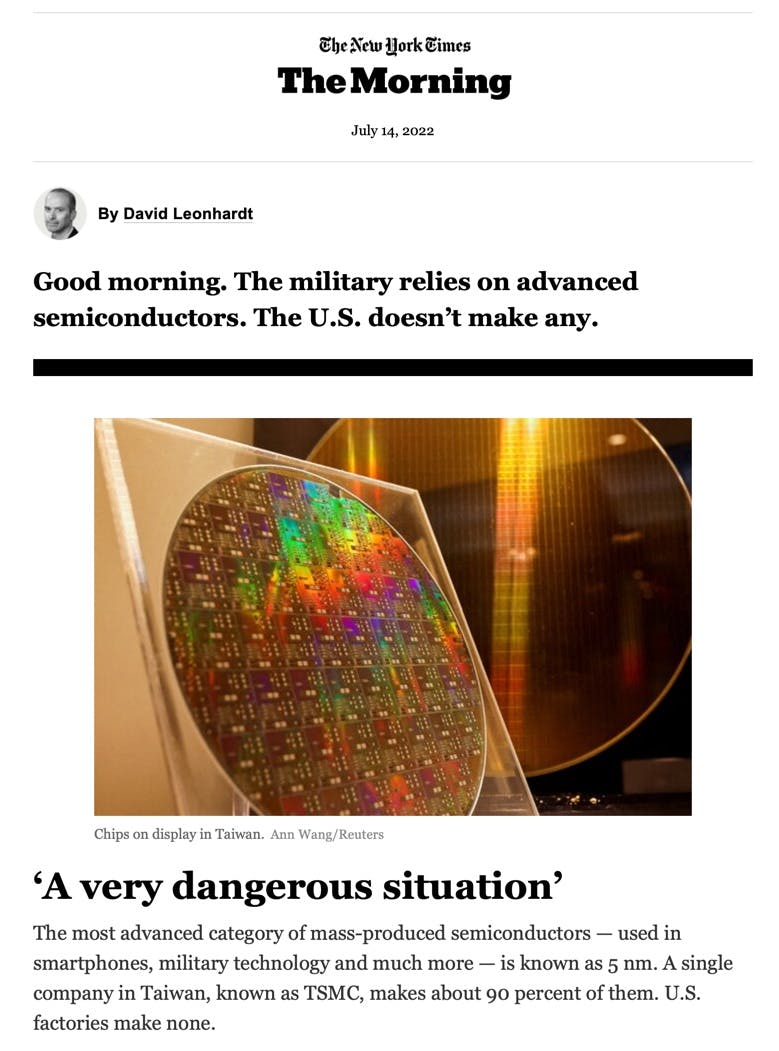
- The CHIPS Act - to address the dangerous semiconductor situation highlighted below
-
- Hinders
- Crypto regulation. It’s not clear where it may go in the USA with the SEC and it’s very differently regulated from country to country internationally.
- Hinders
Geopolitics, conflicts and wars
- Two current examples should make this very clear
- The war in Ukraine, disrupting what was oft described as “Europe’s bread basket” is disrupting both the food supplies in neighboring regions, but equally, via sanctions, the gas supplies to western European countries like Germany that had become dependent on Russian supply.
- Taiwan - China relations, again highlighting the TSMC dependence above
Barriers to entry, Backlash and Burden as you scale
- Barriers to entry can be as simple as competitors blocking your path into the market and the backlash can be as complex as breaking into an ecosystem that rejects you like a body rejects a virus, because it threatens the status quo.
- Who, what and why questions are the key to his section.
Burden as you scale.
Most businesses knowingly or unknowing develop a burden as they grow. It might be a simple as a backlog of features for their product or as normal as an increased need for working capital, or the challenge of hiring quality people at scale.
- What is the burden you will carry as you grow your business? How can you balance it and even use it to your advantage, by for example figuring out where you can develop economies of scale.
Different Forms of DEBT
As you scale your startup, you’ll find it’s possible and even likely to get into other forms of debt, such as technical, GTM and of course financial debt. Unchecked, none of them are good. Yet all of them can be avoided or balanced to avoid them becoming a burden to your business and in fact can become an advantage if planned for and managed.
Technical debt
- If you overlook architectural issues relating to scaling reliably and securely, it will ultimately severely limit your ability to serve your customers. (HBS has many and various case studies of this such as OPower.)
GTM (Go To Market) debt
If you overlook important partnerships that will be necessary to your longer term success in your ecosystem, they can and often purposely will hinder your progress.
- In some cases you will even encounter backlash or resistance from existing players in the market who could consider you as a competitors or a threat, unless you include them in your value chain.
- If you get ahead of this this thinking, can you do a jiu jitsu move with them and turn them into partners, for example as part of your Whole Product solution.
Starting points:
- Be aware of this and figure out how to approach other players in the industry in a way that is not seen as hostile, but instead may even offer them advantage and lead to strategic partnership opportunities.
- Questions to consider include:
- Who are the main players in the market who effectively control the market?
- Get to know them and understand the dynamics of the industry through their eyes. “Keep your friends close and your enemies closer”
- What are all the reasons they could reject or welcome you?
- Who are the underdogs who might view you as a potential help to their cause
- “Your enemy’s enemy is your friend”
- Who are the main players in the market who effectively control the market?
- Questions to consider include:
Startup Secret: When you’re a startup, consider which giant’s shoulders you can stand on to get above the noise, in a mutually valuable partnership that benefits the customer
Financial debt
- As you consider your financing options, you may be tempted to take on debt or even bridge between equity financing rounds
- Debt is rarely the right form of financing for the unpredictable nature of innovation, and it’s why Venture Capital became the prevalent form of financing for startups.
- That said, carefully used it can become an advantage. See examples in the table below.
Timing - your market entry and rollout
- Timing in your value prop / solution can be key in so many regards. For example is the market ready for your offering? Is there Urgency for it? (Refer to the 4U framework)
- Many startups struggle from being too early in a market, where the need is still latent. (See the
 BLAC and White framework). It can be expensive to educate a market to understand why the need is in fact critical, but over time factors such as technological shifts or regulation may drive the need to being blatant and critical. For example the mobile phone took banking to a new level of convenience for consumers and caused banks to consider mobile banking and related services such as payments, and deposits as critical services for them to provide to retain their customers for fear of losing them to the so-called “new banks”. Or in the health world COVID drove not just blatant critical needs such as masks, tests and vaccines but derivative needs such as remote and hybrid working solutions.
 - There’s a balance to timing like everything else in startup-land:
- Enter the market too late and you’ll miss the opportunity to lead it
- Enter it too early and you could be the pioneer with arrows in your back
- For example spending too much to educate the market only to see later entrants capitalize on your work, without that expense and with a better solution from observing your initial product challenges and learning from them.
- Many startups struggle from being too early in a market, where the need is still latent. (See the
Many of these factors also interrelate, such as how you time and pursue your market entry based on funding. See the related article on that here  Funding Market Fit
What other examples of DEBT can you think of?
Please leave your ideas and thoughts in the comments 🙏
Segment them according to what you can control to your advantage
Government regulation that supports or hinders. For example:
Geopolitics, conflicts and wars
🎙 Hear how Michael taught it the lecture, cleaned & woven in
▶ Watch the original lecture
When you build your product, there’s a set of dependencies you must be aware of, which I capture as DEBT. The core idea: your product is very unlikely to be the whole solution the customer needs, so you have dependencies (external factors) that must be in place for your product to actually meet the need end to end.
Take the smartphone. On its own it’s useless: it needs a carrier, and it needs apps (though one app, the phone, is built in). If the phones couldn’t be provisioned on the network, they were just bricks. If you don’t have the app that solves your particular problem, the device is useless to you. So the work is to figure out which external dependencies your product relies on, and to pay attention to them, otherwise you’ll be selling something that can’t actually solve the problem you set out to address.
DEBT is important precisely because these dependencies determine whether people will really commit. If customers can’t rely on the surrounding ecosystem being there, they hesitate to buy, no matter how good your piece is. The workbook has worked examples, including Apple Pay and Tesla, which both live or die on dependencies outside their own product.
View the original page ↗ · note: 1 embed(s) were broken on the source site