 BLAC and White
- BLAC and White moves
 YouTube: A Case Example of BLAC and White
 Netflix, Spotify and JioCinemas in India
The BLAC and White framework is a critical tool for qualifying problems in business, particularly in B2B technology markets. The framework is an acronym where ‘BLAC’ stands for Blatant, Latent, Aspirational, and Critical.
‘Blatant’ and ‘Critical’ problems are acute, often standing in the way of business operations, and thereby pose substantial risks to careers and reputations. ‘Latent’ problems, on the other hand, are often unacknowledged and require significant effort to elucidate and resolve, often leading to costly missionary selling. Lastly, ‘Aspirational’ problems are often unseen or considered as optional to address, often the most challenging for a B2B startup to sell, because they tend to be non-essential improvements or aspirations for the business or user.
The ‘White’ in the framework refers to the concept of ‘white space’ in the market - an area of potential opportunity that is currently unaddressed or under-served. By identifying and addressing such ‘white space’, businesses can capitalize on open areas of opportunity and create unique, innovative solutions.
(For further context of this framework within the overall  Customer Value Proposition
, read the definition in the  Synopsis: Customer Value Proposition
.)
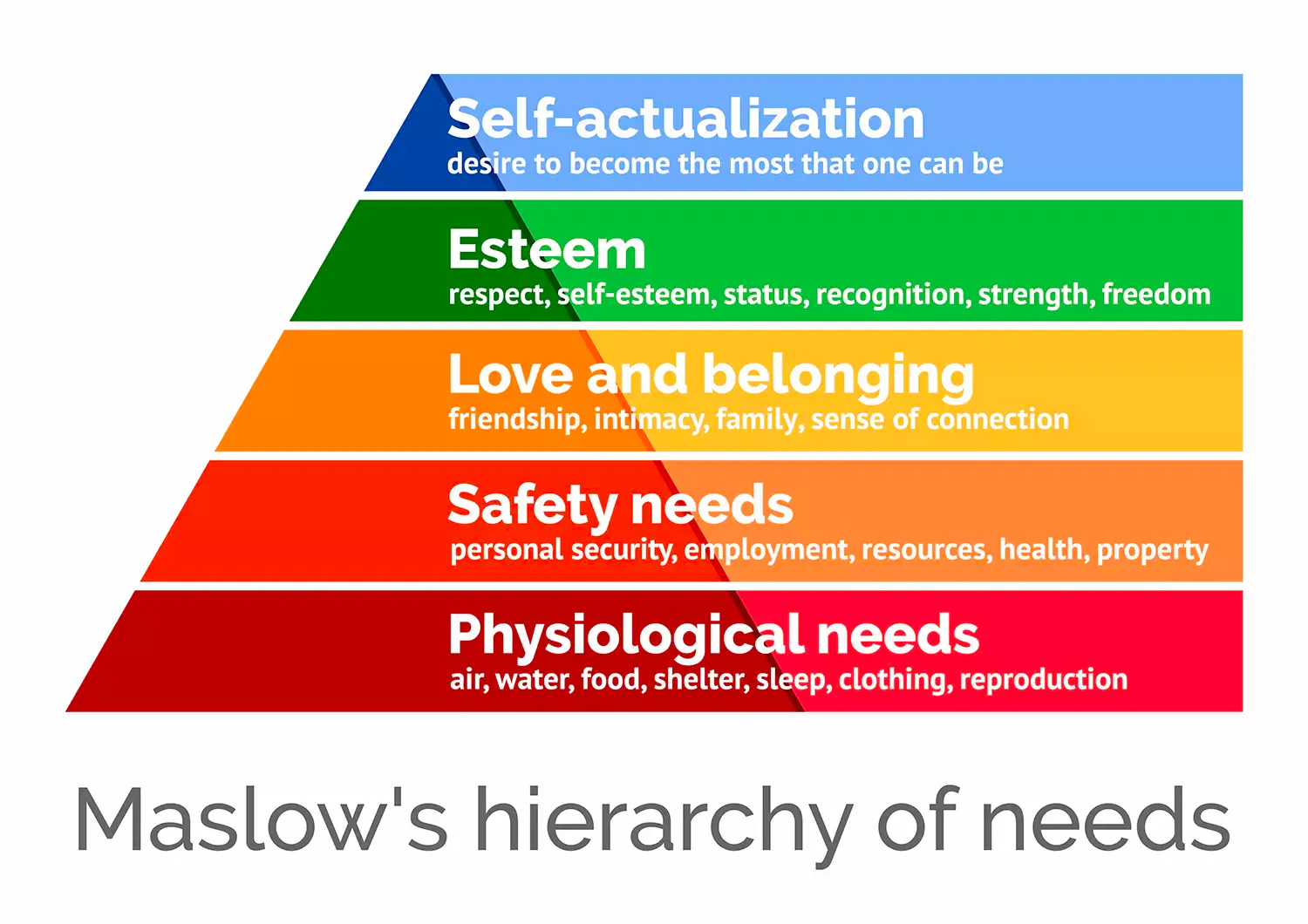
It is worth noting that many successful B2C products expose latent, aspirational needs, operating on a different axis of the framework. A notable example of this is Facebook, which tapped into latent, aspirational social needs to achieve success. This often aligns with Maslow’s hierarchy of needs, where social needs drive the success of certain products or services.
Importantly products can move through the BLAC framework over time. That may be because of market forces or technical advances or a combination of factors. For example initially cell phones were huge, expensive and specialist tools that both because of innovation and cost have of course become blatantly critical now in so much of our lives.
For an example see YouTube: A Case Example of BLAC and White
Read BLAC and White moves to understand how to navigate the 2x2
Equally important is how you as an entrepreneur enable this through a combination of your Vision and Execution. Steve Jobs is famous for this quote, built on Henry Ford’s quote:
“Some people say, ‘Give the customers what they want.’ But that’s not my approach. Our job is to figure out what they’re going to want before they do. I think Henry Ford once said, ‘If I’d asked customers what they wanted, they would have told me, ‘A faster horse!’ People don’t know what they want until you show it to them. That’s why I never rely on market research. Our task is to read things that are not yet on the page.”
One of the reasons this is both an art and a science is that market needs change, and at the same time, technology advances so that at some point what it becomes possible to meet new needs with new technology, such as was the case for the first huge bulky cell phones with brick sized batteries and a basic keypad interface that could only handle voice. Those became pocketable smart phones with touch interfaces that can handle voice and data simultaneously and at high enough speeds to handle multitasking Apps. Quite the evolution!
Startup Secret: At the intersection of changing market needs and advanced in technology lies the roadmap for successful products.
This speaks to a favorite relevant quote:
“The best way to predict the future is to invent it.” - Alan Kay
But be careful you don’t fall into the trap of inventing something that the market never wants just because you want it or it’s technically possible. And even if you have a perfect vision for the market, remember in the end it’s down to how you execute.
The difference between vision and hallucination is execution.*
For example if you have a vision for a new way to track nutrition, that could just be a latent aspirational need for people who want to loose weight. Or it could be a blatant critical need for people who are diabetic or who have medical conditions that are food sensitive or intolerant. Or at the extreme for those who have deathly allergies to certain ingredients. So the segmentation, targeting and GTM execution are what could take it from addressing latent and aspirational desires to meeting blatant and critical needs.
Exercise 1
Place some products we’ll all be familiar in one of the four quadrants below
- Vision
- Eyeglasses
- Contact lenses
- Sunglasses
- Meta RayBan glasses
- Google glass
- Meta quest headsets
- Apple Vision Pro
Fitness/Health products
- Fitbit
- Oura ring
- Whoop Strap
- Apple watch
Blatant
2
Critical
3
Latent
1
Aspirational
4
*Personal note: I spent my life as an entrepreneur balancing vision and execution and whenever I failed it was usually because one or the other was out of balance. My mantra became simply:
- Listen and lead
EG Actively question and listen closely to your customer’s evolving needs and then look ahead to how technology is changing and what will become possible and lead just enough to stay ahead of the evolving problem set.
Incidentally product leaders often pay far too much attention to the competition. Don’t assume they’ve listened closely to the customer when they change their product. Trust your own ears and eyes and if you pay closer attention consistently and out execute them on all other aspects of your business, you can win in the market.
🎙 Hear how Michael taught it the lecture, cleaned & woven in
▶ Watch the original lecture
The 4U’s work beautifully in B2B. For consumers, and for problems that aren’t yet on the surface, I use a second framework: BLAC & White. (The mnemonic comes partly from great whiteboard thinking my colleague Adam Barry did with me.)
Plot needs on a two-by-two. In the bottom-left corner sits the latent and aspirational need. In the top-right sits the blatant and critical need. Consumer needs are often latent: they’re sitting there, but not on the surface, and people can’t articulate them clearly. Adam’s classic example is the iPhone. Steve Jobs did essentially no market research, because if you’d asked people, “Do you need a computer in your pocket that finds where you are, tells you which restaurants to visit, lets you send a picture to your girlfriend, and play a game flinging angry birds at pigs?”, they’d have said no. But if you watch people (they get lost, they get bored, they want to share things with friends), you realize those latent needs are real. Tap into them and they become blatant. That’s why, when I asked who’d take an iPad away from someone who owns one, the answer was “I’d be very sad”: you didn’t go looking for an iPad five years before, but now you organize your life on it.
Aspirational needs are also real, just different. Ask how many people spend time online looking at fashion or things for their home, and lots of hands go up. Is that a burning need or an aspirational one? Aspirational: “I want my home to look beautiful; I want to feel appropriately dressed.” Notice the fashion business held up far better than the economic climate would predict, because people keep spending on aspirational needs. They’re genuine, they just sit in a different quadrant.
Where you really want to be is blatant and critical: needs that are immediately obvious and where, if you can’t solve the problem, something goes badly wrong. In business, that’s usually a broken, mission-critical (or near-mission-critical) business process. It’s not that a blatant-critical need can never be outweighed by other priorities, but it stacks the deck in your favor. This is exactly why understanding whether you’re solving a vitamin (nice to have, skip a day and it’s fine) or a painkiller/penicillin (skip it and you’re in serious trouble) matters so much.
For consumers, the underlying needs map to something like Maslow’s hierarchy (social, security, physical, economic, recognition, responsibility). Take social: do people need to connect and communicate? Absolutely; we don’t like to exist in isolation. Do you know the number one cause of unhappiness in the world? Loneliness. The longest study of happiness ever run at Harvard, going back to 1938, found that the single biggest driver of happiness is connection. That’s the need Facebook (and social networks generally) address, and it started on college campuses precisely because people wanted to connect, group, and date. The dating industry is enormous for the same reason. And these needs can escalate to unworkable: for people in foreign nations, staying in touch with family back home was unworkable when phone calls were too expensive, which is exactly why WhatsApp took off. Whole industries build on this: financial services in the developing world were incredibly expensive, and social platforms like WeChat and Tencent in China solved basic payments and money transfer on top of the network.
Disqus is a great consumer example that also has a latent layer. It’s the largest commenting platform on the internet, with around 900 million unique visitors a month across roughly two million sites (about 75% of articles on the web have that comment box at the bottom). The obvious need it meets is old-fashioned “letters to the editor”: people have always wanted to voice their opinion; now they do it in a new form, in real time, building community around a publisher’s site. But there was also a latent need underneath: people want to discover new content. Because Disqus sits across so many sites, it knows that when you read a digital-camera review on DPReview, then something on Engadget, then something on CNN, it can recommend genuinely relevant content, and that discovery layer is how the company monetizes six billion pages of traffic. Beautifully, Disqus is a multifaceted value proposition where several parties win at once: users get to communicate (they stay loyal because they come back to see the replies), publishers get engagement and loyalty and therefore better advertising revenue, and advertisers get broader reach. Multifaceted value props are hard to find, but when you can build one, they’re wonderful. Its defensibility, by the way, is the network: it’s the largest Python app on the web, publisher-centric and user-centric in a way that a single publisher like Condé Nast couldn’t replicate, because they’d be limited to their own commenters, whereas the cross-pollination across all those sites is what makes it interesting.
Rent the Runway ties several of these together across the B2B/B2C line. It’s unworkable for people who can’t afford to buy an outfit for a one-off occasion, underserved because the only prior alternative was spending a lot of money on a single wear, and even unavoidable for people who feel they must show up looking smart (not in their boyfriend’s hoodie). One customer used it because she was going to an event in DC, knew she’d be photographed a lot and would never want to wear that outfit again. Another used it as a foreigner with only basic clothes in the US, invited to a nice event. Interestingly, despite a strong value prop, Rent the Runway has struggled as a business, because its business model is tough. That’s the reminder that a great value prop is necessary but not sufficient: if you can’t make it economically viable, it won’t be sustainable.
The “White” in BLAC & White is white space: can you find an open area where blatant, critical needs are underserved, that nobody has yet figured out how to solve? If you can (ideally in a way you can also capture and defend, and deliver uniquely), that’s when investors and customers start paying serious attention.
View the original page ↗ · note: 1 embed(s) were broken on the source site