 Idea-to-Impact - (Alpha - WIP)
Your guide to getting started finding fit or forging the future
🚀 Where Do Startups Really Start?
Startups start in all kinds of ways. Sometimes they begin with a flash of insight—an idea that won’t let go. Other times, they’re born from pain—a problem so persistent it demands to be solved. And increasingly, they’re unlocked by breakthrough innovations—like mobile, AI, or CRISPR—that open doors we didn’t even know existed.
Whether you’re starting with a problem, an idea, or a new possibility, the key is knowing where you’re starting****—so you can figure out where to go next****.
Because here’s the Startup Secret:
An idea without a problem is like a key with no lock. 🔐 Even a powerful innovation isn’t a startup until it opens up an opportunity for people to unlock value.
So the real journey begins when you ask:
“What does my idea or innovation unlock—and for whom?”
That’s where your startup story takes shape.
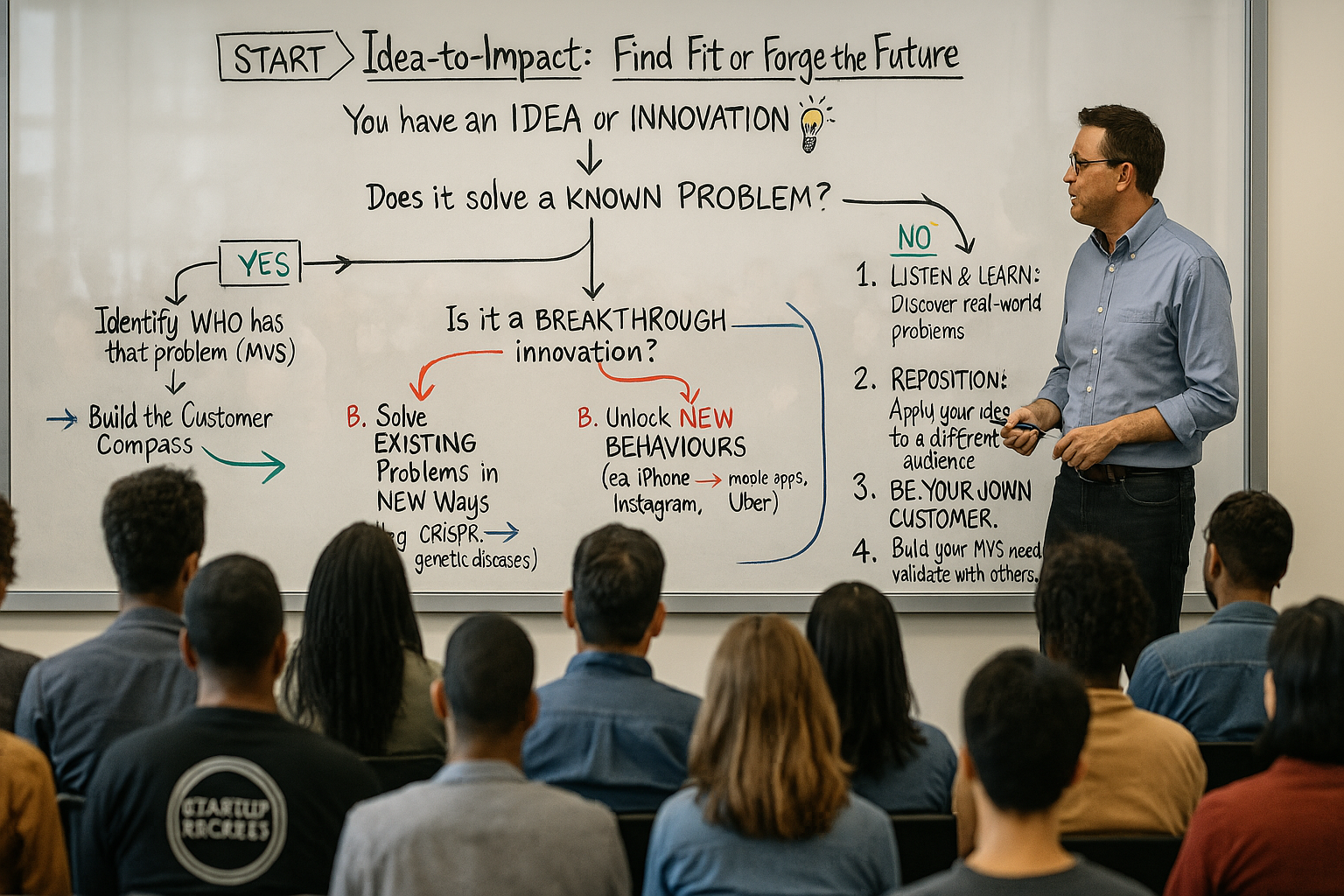
🧭 Idea-to-Impact: Find Fit to Forge the Future
The Startup Journey has to start somewhere. Where does yours start?
Understand Your Starting Point:
START -> You have an IDEA or INNOVATION 💡
│
▼
Does it solve a KNOWN PROBLEM?
│
├── YES ->
│ Identify WHO has that problem / need
│ Find people who have the same or similar needs as potential customers- [Leads to defining your Minimum Viable Segment (MVS)]
│ -> Begin building the Customer’s Compass to understand how to navigate your potential customer’s world
│ -> Confirm your Customer’s Problem Defintion (CPD) as the customer would state it.
│ -> Assemble and test the Customer’s Value Proposition (CVP)
│
└── NO -> Is it a BREAKTHROUGH innovation?
│
├── YES -> Explore NEW USE CASES & Early Adopters
│ ├── A. Solve EXISTING Problems in NEW Ways (e.g., CRISPR + genetic diseases)
│ └── B. Unlock NEW BEHAVIORS (e.g., iPhone -> mobile apps, Instagram, Uber)
│ └── C. Open up entirely NEW OPPORTUNITIES (e.g. AI -> Agents -> Augmented Humanity in education, work, play, ++ )
│
└── NO -> Then get customer-centric:
├── 1. LISTEN & LEARN: Discover real-world problems
│ ├── Adjust your idea -> Iterate to fit
│ └── Reframe around their needs -> Solve what matters
├── 2. PIVOT: Apply your idea to a different audience
├── 3. BE YOUR OWN CUSTOMER: If it solves *your* need, validate with others
│ └── Find others like you -> Build your MVS (Minimum Viable Segment)
└── 4. PARK IT & REFRAME, RETIME: Great idea, wrong timing? Shelve it until possible fit emerges.
If you follow the flow from the top down, unless you have a clear breakthrough innovation, your likely next steps are to define your  MVS - Minimum Viable Segment of people who have the problem you want to solve. Then get inside their heads and their world, building a Customer’s Compass, then based on that understanding, define the problem from their point of view and finally use that to build and test the
  Customer Value Proposition .
💥 Real-World Examples
Known Problem → Better Solution
- Slack simplified chaotic internal communication into seamless channels. (Started as a gaming company)
- Canva made design accessible to non-designers with drag-and-drop ease.
Breakthrough Innovation → New Possibilities
- iPhone turned a phone into a platform—enabling Uber, Instagram, and the entire app economy.
- AWS allowed startups to launch globally with no upfront hardware—unlocking Stripe, Airbnb, and thousands more.
- OpenAI’s GPT models turned AI into usable tools for writing, coding, learning, and more—sparking a global productivity shift.
- CRISPR enabled precise gene editing, revolutionizing biotech and unlocking cures once thought impossible.
🎯 Example Questions Every Founder Can Ask
- Am I solving a known, painful problem?
- If not, what new possibilities does my innovation enable?
- Who cares most about this—right now?
- What’s the smallest group of people with the biggest need?
Startup Secret
“A startup doesn’t just start with an idea. It starts with what that idea or innovation unlocks—for someone who truly needs it.”