 Framework - GTM overview
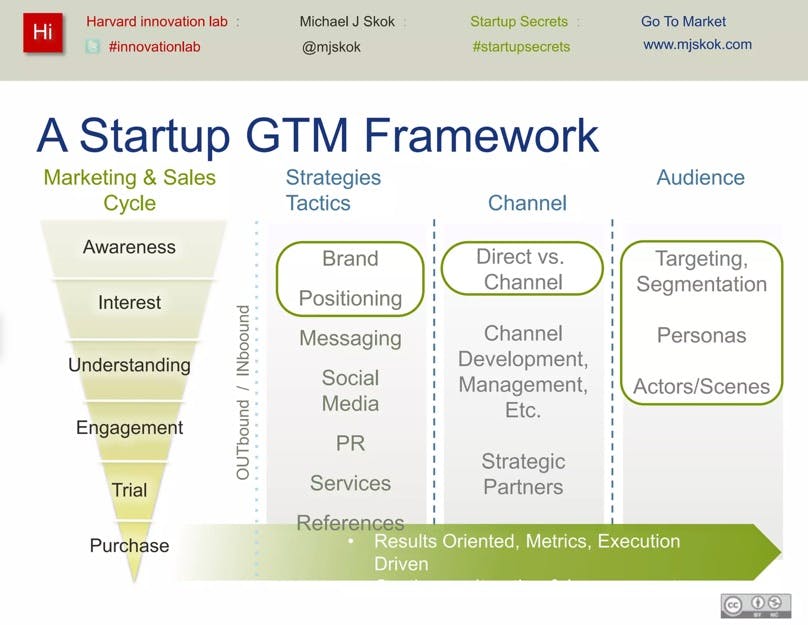
This is the overview Startup Secrets GTM Framework
🎙 Hear how Michael taught it the lecture, cleaned & woven in
▶ Watch the original lecture
The Go to Market Framework
This is the connective framework beneath everything: brand, positioning, targeting and segmentation, the actors in the sales cycle, qualification, driving the cycle, gain and pain, core with multipliers and levers, whole product, inbound versus outbound, and measurement. The full guest case studies that bring each of these to life are gathered in the articles that follow.
Brand
My guess is you all know some brands. If I say Dr Pepper to you, you probably think something different than when I say Coke. That is what is so fascinating about brands. When someone in the audience says their favorite brand is Apple, “because it looks good, it is sleek, it is quicker to access information, and you do not get a virus,” that is brand for you. Here is the thing: there are actually thousands of viruses on the Macintosh. I used to make a fortune at Symantec selling antivirus products for the Mac. But the power of Apple’s brand is that you are convinced they do not have viruses. That is marketing. The essence of Apple’s brand has a customer convinced she is going to be virus free. That is a fantastic thing to be able to do.
So a brand is not a name and not just an identity system. It is every touch point and every product that it influences. And it is a science unto itself.
Startup Secret: Your brand, to start off with, is not your product or your service. It is you, individually, and as you hire, it is your people and what they believe in. If you want a brand that is considered world class, it starts with hiring world-class people who share a consistent view of how you want to represent yourself. Your culture is also your people. One bad apple can bring down the whole team.
After that, it comes down to how you execute. If you keep promising things and do not deliver, your brand will collapse fast. Execution is never something we can skip.
The vision, promise, and expectation framework
First, decide your vision: what you want to do to change the world, the promise you set out, and ultimately the expectation you set for the customer. If you set an expectation too high (say, “the world’s greatest cell phone network, coverage everywhere, and the cheapest”), you had better be able to deliver on it. The real issue consumers have with cell phones is that the expectation is set (coverage everywhere, highest speed, lowest cost) and yet the experience is very different: they fight over bills, get throttled, cannot get coverage. They have broken the promise. I only know this because I used to be in the business of watching all those customer complaint analytics pull through.
So figure out how high to set the bar and what promise you can over-deliver on. If a prepaid carrier just said, “We are going to give you sucky coverage but it is really cheap,” you could make an informed decision and be happy. Or you pay a premium for really good coverage. Having a vision, and setting out a promise you can beat, is the first part of your brand, and it is the first thing I see startups do wrong. Entrepreneurs are out to change the world, so they make bold claims. Do not start by saying you will change the face of health. Start simpler, something you actually do when you start out, so you can over-deliver.
Attributes, proof, and emotion
Attributes (sleek, simple, and so on) are worth defining early, usually around your product. They often focus initially on how you are different, what you do that is better. That is fine, but what is really important at some point is why you are unique: what can you do that nobody else can.
The key word here is proof. You can claim all the attributes you like, but until somebody says it back to you, it is meaningless. Your claim is whatever you like, but the taste test is either that Pepsi is better than Coke or it is not, and until that is coming back from your audience, it is meaningless.
Startup Secret: Do not believe your own BS. Go figure out what the customer is actually telling you about your brand before you claim anything. There is a tension here: claim too early and you may be premature; claim too late and other people will define your brand before you have time to form it.
And in the end, people buy things for emotional reasons. Everything you are wearing tonight is in some form individual to you. You have to establish what you want people to think of in an emotional sense when they connect with your company.
Consistency and customer intimacy
What this all sums up to is how you are perceived, and it is all about consistency. To get brand integrity you need consistency about everything you do, in how you set out your agenda and in every interaction with your customer. Even something as basic as how you establish a culture with your customers. Almost every successful startup in my portfolio right now has extraordinary customer intimacy. That is a brand attribute. It says you care about your customer, and it costs you nothing but sweat equity. Do not do it if you do not believe in it, though. Maybe you will be a low-cost provider like Amazon, where it is convenience and cost, not service, that matters. When we ask an audience why they use Amazon, they say low cost, then even more say convenient, then one or two say it is the only way to find certain things. That is Amazon defined. Bezos would consider that cultural: from day one he made his desk out of a door because he wanted a low-cost culture all the way through, even into AWS, where they continuously reduce cloud prices.
Apple’s 1977 philosophy, and impute
Startup Secret: Start how you mean to end. This was Mike Markkula’s statement of Apple’s marketing philosophy back in 1977, and it barely changed. It created some very emotional verbs. Empathy: they truly want to understand customer needs better than any other company. Jobs’ view was that the customer is always at the heart of the thinking, and if the customer does not like it or cannot use it, that is Apple’s problem, not the customer’s. Focus.
And my favorite word: impute. People do judge a book by its cover, and they impute value from the minute they see a package. I used to call it “new product glamour.” When you open an Apple product to this day, even the packaging imputes value in how it is put together and how it feels. Apple did this so early that they have one of the most valuable brands in the world, and it has stayed very consistent. If you do not start early and you keep iterating around it, it is very hard to get consistency, to reinforce, and therefore to build on.
The brand essence, and its components
Beneath every powerful expression of a brand (the Nike swoosh, the BMW grille, the Nordstrom service, the Harley-Davidson sound) sits a core idea I call a brand essence. Your name, logo, website graphics, the voice on your voicemail, all the ways you touch customers, are expressions of that essence. And that essence starts with you, the founder, and the culture. If what you are trying to create as a brand is inconsistent with your culture, it will break as you add people. It will not have integrity.
A brand essence has four pieces:
- Vision. Not a product roadmap, but a vision for how the world is changing and how your product reacts to that change. Nike, in the 1970s, tackled the emergence of the amateur athlete and the personal health movement.
- Promise. What the brand represents to the customer. Nike’s promise: wear our gear and you will run as fast as you can, jump as high as you can, achieve your true potential. When you break that promise, you pay for it, because customers know right away.
- Attributes, at three levels. Your spike, sometimes called the one simple thing, a single core idea that unifies everything (Zipcar: freedom; Nike: performance; Puma: style). Three or four differentiating attributes that make you special (ColdFusion: speed, you could write applications faster than anything else). And cost-of-entry attributes you simply must have (cars: safety; databases: scalability and reliability).
- Personality and style. Brand is emotional, not just technical. If your brand were a person, what would their personality be, friendly or aggressive, creative, playful? And what would they wear? Chanel is classy, Victoria’s Secret is sexy, Oracle is stark, Apple is elegant. Steve Jobs was literally a manifestation of Apple.
Great brands are consistent, they represent the values the company is about, and they are reliable: they always keep their promise.
Positioning
The first part of positioning is to occupy a distinct place in a potential customer’s mind, hopefully consistently. If the customer can identify that what you do is unique, you are in a great place. The biggest challenge I hear over and over is a founder saying they have no competitors, and yet they are in a category that already exists, competing for a finite pool of dollars.
The reality: even if you have a completely unique product, you compete for dollars and time. Companies write budgets a year before you ever come near them, so they will have to take from someone else’s budget to buy you, and you are always vying for busy people’s time. So positioning is about finding a unique white space where you can own some segment.
Differentiation is not just technology
The typical mistake is to think differentiation is always technology. That is often a great starting point, especially with a disruptive technology, but it does not have to be. You could differentiate by targeting a segment nobody has served before. You could differentiate with a business model. If you can find multiple things that let you defend a unique white space, even better.
Business-model differentiation can be devastating to incumbents. Google made money from advertising rather than selling software, and suddenly Microsoft, which made millions from Office, faced a competitor offering the equivalent for free. You cannot fight that. You cannot write off billions of revenue and fire thousands of people in your Office division to compete. That is the classic innovator’s dilemma, and we have one of the best people in the world to teach it here at Harvard in Clayton Christensen. It was not a technology differentiation, it was a business-model differentiation, and it cost Microsoft a dial-tone stock price for years.
Barriers to entry and sustainability
Once the big players see you are onto something, they will come after you, so build barriers. Better-faster-cheaper is not sustainable when competitors can out-resource you and give things away. IP and patents help, but I like to get you thinking beyond that, because patents also expose your method. What if you developed a network that had not been developed before, a supply-chain network or a network of users? What is defensible about Facebook is not the software (in open source you could rebuild photo sharing, a stream, and so on), it is the network. Most of the interesting plays on the web are not software: Yelp is the reviews and the data behind it. Amazon is one-click buying, taking a painful checkout and making it virtually instantaneous.
So find your sustainability in things like a network, data, or a clever process, not only technology.
Mapping it: pick real axes
Because we are at Harvard, put it in a 2x2. Size the bubbles for relative competitor size, but the axis choice is critical. The typical high-low graph uses faster-better, and people pay too little attention to the axes. What you want is axes that define real barriers, so competitor B cannot move into your box.
On-premise versus cloud (SaaS) is a great barrier. To create a product that sits on-premise is architecturally very different from one you take to the cloud, where to share resources you have to do multi-tenancy, keep everyone in sync on releases, and yet still let customers customize (Gucci does not want to look like L’Oreal). That is very hard for legacy on-premise companies to cross. Closed source versus open source is another: it changes whole business models. It is the difference between Sun Microsystems, not even in business today, and Red Hat, an eleven-billion-dollar company. So pick real axes that let you define and defend a white space, not just faster-better-cheaper.
Targeting and Segmentation
The perfect startup storm
If I could define the perfect startup storm it would be three things: a disruptive business model, a disruptive technology, and a new market with a great go-to-market approach. When I evaluate investments I look for at least those three, and usually I find only one or two, which is fine to work on. But everything I have been talking about impacts more than product-market fit. It impacts packaging and pricing (B2C versus enterprise; government cares less about price and more about security, compliance, clearance, and specific channels; healthcare is one of the most complex markets because it is hard to know who the ultimate buyer is). And it impacts distribution and messaging. To state the obvious, if you do not know the segment, you will never hit it. So everything depends on targeting and segmentation.
Big market, small segment: MVP and MVS
Is it better to go after a big market or a small market? Both answers are right, and the trick is to figure out how, where, and when. As a startup you have very little resource. If you go after a large market and try to serve all its needs, you will be very challenged, because large markets have diverse needs by definition. If you can define a nice small segment, then your product-market fit, your packaging and pricing, your channels, and your messaging can all be that much more focused. So if I had been fair I would have said big market, small segment.
Most of you know Eric Ries’s Minimum Viable Product. The MVP comes from figuring out the minimum you can do for your customer. But I would argue the Minimum Viable Segment is just as important, and I do not hear anywhere near enough work on it. We are looking for the place where your MVP and your MVS overlap, which gives you a smaller target to cover, and therefore the basis for a smaller product definition, not a larger one.
Startup Secret: The MVS is the dance partner to the MVP. Find the overlap and you can target a much smaller, winnable area.
A segment is a common set of needs
So what is a Minimum Viable Segment? One simple thing: a common set of needs. People tell me their segment is “finance,” or even “insurance.” But if those insurance people have completely different needs person to person, you probably have not found a segment. By contrast, I have seen great products span industries (insurance, banking, even different applications) that share a common need, maybe something as basic as very close customer intimacy.
Here is why needs matter. If someone sitting next to you says, “I love these snow boots, I have never been so warm,” and they see you have leaky shoes, that is a reference: someone with the same need experiencing the same conditions. But if I try to sell snow boots to someone in South America who has never seen snow (same gender, same demographic, same buying power), wrong geography, we have a problem. Get matching needs and figure out if they can reference each other. Then you get referencing: “I have that same need and you had a good experience, so I will take your word for it.” That is far more powerful than you claiming your product is great. That is your initial beachhead. My good friend and early mentor Geoffrey Moore, whom I brought to the i-lab, talks about all this in Crossing the Chasm as creating your beachhead. Once you win that initial segment you can declare victory: “We are the leader in providing X for Y,” and that reinforces your brand.
Startup Secret: A segment is a common set of needs. Find customers who share needs and can reference each other, and you win a beachhead.
Do not default to verticals or size
In business school you hear “go pick a vertical like automotive or government” or “segment by size, SMB or enterprise.” I would far rather you figured out the common set of needs. A regulatory-approval process, for instance, can apply across many verticals (pharma, financial services, government all need it) and across company sizes. Sometimes this is called a diagonal, because it cuts across verticals with a single problem set. Verticals and size may play a part, but the key is consistent needs.
Drill down to a critical need
Take apps: there are hundreds of thousands, and nobody can find what they want. I do not buy the “there are a hundred million smartphones, so one percent share at ten dollars is a ten-million-dollar business” story. Here is a better one. Suppose your app could target mobile professionals, or just office workers. Drill down: white-collar or field workers. Service people or salespeople. Service people servicing medical equipment (Agilent) versus salespeople selling office equipment (Pitney Bowes). That medical equipment in hospitals versus clinics. Critical care versus diagnostics. If I can sell to a mobile professional in the field who services medical equipment in hospitals used for critical care, where when they go wrong people die, that is a critical need. I have not segmented by anything except thinking through where a need might be critical, and “I have an app that helps save people’s lives” gets attention.
Back in the value-proposition class we talk about blatant, critical needs rather than latent, aspirational ones. But note that aspirational and even latent needs can build great companies too. Someone asks about fab.com: you can live without those designs, yet the company is successful. Exactly. The iPhone met a latent, aspirational need. Nobody knew we needed a pocket computer with GPS that measured every heartbeat and step, but once you have it you will not give it up. In the consumer world these can be social needs, physical needs, economic needs, the need for recognition (which plays right into a compensation product). Our framework for teasing them out is called BLAC and White: how you identify blatant and critical needs versus latent and aspirational ones.
Focus, again
Startup Secret: The single most important word for a startup is focus. The number one problem I see in execution is people going too big too fast and contracting on failure. Would you rather expand on success or contract on failure? Start with an incredibly small segment and a focused MVP, meet that need uniquely well, and even if it is for one customer, build on it, make the next one successful, reference them, and grow. Be patient enough with yourself to work through what the segment is.
Actors, Personas, and the DMU
Segmentation gets you to a target. The next level down is what I call actors, sometimes called personas. I use actors deliberately, because the actors change through the scenes of your sales cycle, and one of the biggest things startups miss is exactly that.
You do not end up with one buyer. You get a series of actors:
- Visionaries. Critical in early markets. As Geoffrey Moore teaches, visionaries and early adopters get enough vision to see competitive advantage in your breakthrough. But visionaries rarely run the business and rarely sign the check.
- Technocrats and operators. If you sell a brand-new NoSQL database (a new way of storing data for web applications, like our company Couchbase), you go beyond the visionary to the database administrators and the people who run the data centers. At AOL, the visionary who wanted new applications was not the person running the data center.
- Influencers. Often several people, highly respected, carrying weight not necessarily from their title but from tenure or a track record of introducing successful projects.
- Economic buyer, who writes the check (often a CFO).
- Decision maker, who might be different again (often the CEO).
Each actor has a different role and, crucially, different motivations, so they need different messages. The visionary wants competitive advantage. The operator does not care that your technology is better, just that it runs efficiently, is cheaper and faster. The economic buyer is focused on KPIs. If you have one value proposition for everyone, you will fail with most of them. And the actors change as you move through the cycle: early on you look for visionaries; toward trial and purchase, economic buyer and decision maker become key.
At the bottom, the purchase is made by everyone coming together, which we call the decision-making unit (DMU). Good salespeople figure the DMU out early. It matters even in B2C: I might think I make my own decisions, but my wife runs the budget, and no family buys a house with one person deciding.
Qualification
Startup Secret: Qualify early and often. It is so obvious I am almost embarrassed to say it, and yet I do not see enough of it. Why does it matter? You do not want to spend money on things you cannot win. The later you qualify, the longer you will have spent time, money, and energy taking someone through a sales cycle before you find out whether they even have the authority, need, budget, or timescale.
The other word an audience member gives me is viable. A customer may not even have the infrastructure to support your product: no controls, no firewall, no trained people, no defined internal process. There is no receptacle for the product yet. Qualify early to save total dollars and time, and qualify often because things change during long sales cycles: mergers, job changes, shifting responsibilities.
Play hangman with the qualifiers. I grew up with one called MANACT:
- M is for Money. Do they have budget?
- A is for Authority. You need to be able to sell it internally; even if it is purchased, if it does not get rolled out by someone with authority, you get no repeat business.
- N is for Need. The more painful and urgent, the better. This is all back to the value proposition.
- A is for Ability. Do they have the ability, and is the solution viable in that organization?
- C is for Competition. Even a unique product competes for dollars and time. Do not exist in isolation of everybody else.
- T is for Time. Is there urgency? New regulations, for example, make archiving urgent; without a trigger it is just added cost.
Some people call a similar framework BANT. In an integrated world, agree with sales what qualification means: marketing qualified leads (MQLs) become sales qualified leads (SQLs), with agreed qualifiers. And ask the best question of all: not why did someone buy, but why did they not buy. That helps you narrow your segmentation.
Driving the Sales and Marketing Cycle
I use a driving metaphor because it captures what you control and what you do not. You control the gears (going from neutral to overdrive with your marketing tools and sales approaches). Unfortunately, the customer controls the accelerator, the brake, and the clutch. It is like teenage driving: you are trying to teach control, but they are in the driving seat.
Gears: you cannot skip them
The gears are your sales and marketing tools. Can you skip steps? Not really. Just as it is hard to go from neutral to fifth gear, you cannot skip awareness, interest, understanding, and engagement and jump straight to purchase. It is pretty hard to get somebody to buy something they do not even know about. Someone storing mission-critical data will not buy without a trial, especially from a startup, because a startup is a risk and buyers try to de-risk with proofs of concept and trials. If you can figure out how to skip a step, great. Unidesk used to do proofs of concept one hundred percent of the time; now they can skip roughly forty to sixty percent, partly by using the channel to lend credibility.
And do not over-rev. If you keep selling in the same stage (best trial here, best brochure there, best offer here) without moving the customer forward, you frustrate them. Move the gears to move the customer from stage to stage.
The customer’s controls
- Accelerator. What motivates the customer from one step to the next. A slippery product (simple, lightweight, easy to install, self-service) accelerates them. The HubSpot Grader famously did this: make it very easy to work with you and to touch you.
- Brake. Comes on when the customer does not understand what you are selling, how it works, whether it meets their need, whether it feels too expensive, or how you compare to competitors. Answer those questions or they will stop to evaluate.
- Clutch. They engage it anytime they are stuck, when it is not clear what to do or there is no call to action. Give them a reason to move from step to step: an incentive, a promotion, a reference customer, some competitive juice (“I do not want my competitor running away with this”).
Startup Secret: The customer owns the clutch. Listen carefully for whether they are ready to move step to step, and if they are not, do not push. If you jump them to purchase before they understand, you will annoy them and lose momentum. And when the cycle stalls, it is your issue, not the customer’s fault. Actively listen: sit next to the rep doing the dialing, dissect every objection, and find the next gear (often a different pricing, packaging, or deployment model).
Gain and Pain
Running underneath the driving metaphor is the gain-pain ratio from the value-proposition class. There is always a set of things on the customer’s mind.
On the gain side: are you increasing their revenue (always the best gain), saving cost, reducing time, saving people, giving competitive advantage (often key in early markets), or improving reputation? Move instant validation and gratification as high in the cycle as possible.
On the pain side, which startups forget: finding you as a startup is a challenge, trialing costs money, buying takes consideration, and most overlooked of all is implementation and deployment. Those of you here for the Actifio case saw the fastest-growing storage startup ever grind to a halt on rollout, because it was selling software to manage virtual storage and solve the copy-data problem, but buyers were used to buying storage as boxes they roll into the data center. We were giving them one thing and they expected another. It needed repackaging into a whole product they could just plug in, so we included the storage and everything else needed to make it easy to trial and roll out. Training is the most overlooked pain of all: even a highly valued SaaS company like Workday had to work through retraining people who used SAP.
As a startup, your gain-pain ratio has to be about an order of magnitude better than doing nothing to overcome the inertia and risk you always carry. One in a hundred startups really breaks out; one in a thousand becomes a ten-year success, and customers know that. The default is to do nothing, and good enough is good enough. So all the way through the cycle, build the case that this is an order of magnitude better than doing nothing and worth the risk on you.
Startup Secret: Good enough is good enough. Unless your gain-pain ratio is roughly 10x, the customer will default to doing nothing.
Core, Multipliers, and Levers
From the business-model class: build a core of your real capabilities, then add multipliers and levers.
Multipliers accelerate you. The channel is the classic multiplier: if you sell every product yourself, your reach equals your headcount. Other multipliers include tiered pricing, slippery products, freemium, and a whole product that pulls you to market. In my own past, we sold the first real-time inline analytics product (before everyone called it big data it was business intelligence), a great value prop, but getting the data to answer the questions was the real work, and we were the tip of the iceberg. Only when we partnered with data-warehousing vendors and then systems integrators like IBM did the business take off. We were pulling IBM’s product through on a ten-to-one basis, which is why they ended up acquiring my company.
Levers reduce the brakes. Inside sales instead of outside sales; inbound instead of outbound; reducing support and services and, above all, training. I have seen the best startups package an out-of-the-box experience up front: they give away the service, the implementation, and the training, and get the product up and running before the customer has to evaluate. Why? It accelerates the cycle, and if the ultimate purchase is an order of magnitude bigger than the cost of that experience (and especially if there are repeat purchases), you are in the money. This is the cost of customer acquisition versus lifetime value: if there is a huge multiple on lifetime value, you can afford to give upfront service to get adopted quickly.
Whole Product, Slippery Products, and Services
A whole product, as Geoffrey Moore explains, is the entire solution to your value proposition. If it meets only part of the need, it is not a whole product. Actifio needed to include the storage. Demandware built its link program to complete the e-commerce solution.
Slippery products are how R&D drives marketing and sales. Make the product simple, low initial cost, easy to install, with value proven quickly up front, playing well with what it integrates with, obvious ROI, so it is a “why not” rather than a “why would I.” R&D and sales can get along famously: sales still picks the right segment and answers objections, but R&D makes the product frictionless.
Do not forget services. At the bottom of the cycle, support and services people are often the best way to engage, because customers do not view them as a threat the way they view salespeople. They are seen as helpful, supportive problem solvers, and they help both at the end of the sales cycle and in extending the customer lifetime value. It is a whole subject, with what I call the seven golden nuggets of professional services and the seven deadly sins, all on the website.
A self-service portal is a great example of taking friction out and scaling. Symantec serves tens of thousands of articles in self-service, provided by nearly a quarter of a million users Symantec does not pay, on a portal built by our company Acquia. That is scalable, automated support.
Inbound versus Outbound
The old world was all about outbound marketing. The playbook: buy a list of email addresses, bang people over the head, hire young and hungry telesales reps to cold-call, spend on Google AdWords, hire a PR firm to interrupt journalists, do TV and radio. That worked for a whole generation, but there is one problem: you are reaching a lot of people who do not want to hear your message. People are sick of being marketed and sold to, and they get good at blocking it out: DVRs, caller ID, ad blockers, spam filters, priority inboxes. It is nearly impossible to reach someone with the traditional playbook today.
Inbound marketing rethinks this to match how humans actually shop and learn. Two things I love about it. First, success is more about the width of your brain than the width of your wallet, which is perfect for startups. Second, it scales differently. Outbound is like shoveling money into a furnace: put a dollar into AdWords, get a dollar-ten out, and the moment your budget dries up, the asset is gone because you were only renting it. Inbound builds your own audience: modern marketing assets on your balance sheet (links into your site, keywords you rank for, pages, Twitter followers, Facebook fans, LinkedIn members). You create a piece of content today and it is an asset that keeps pulling in customers essentially forever. You own it, you are not renting space on Google or Facebook.
To do it, stop thinking like a marketer and think like a media company: be Oprah for your market. Turn your website into a magnet with remarkable content (brilliant blog articles, ebooks, webinars). The better it is, the more retweets, likes, and links it gets, and links are to the internet as dollars are to the economy. Your site starts like Cambridge and you want to turn it into New York City: bus stations are Twitter, train stations are Facebook, airports are LinkedIn, and the highways are links from other sites.
Startup Secret: The modern moat is inbound. As Warren Buffett tells his CEOs, build a moat, make it wide and cold and put sharks in it. The modern moat is not a patent, it is how many links, keywords, and fans you have, and that is very hard to replicate. If I wanted to bury Zappos, I could copy the website, the culture, the inventory, and the supply chain, but I could not copy Tony Hsieh’s millions of followers, the five hundred thousand links, and the millions of keywords they rank for. That is a nearly insurmountable competitive advantage.
Outbound still has its place. If you are Salesforce or IBM with a big brand and you cold-call, people might pick up. If you are an unknown startup selling performance-management software, that is an extra-special waste of time. Outbound tends to start working as you get bigger and as deal sizes grow. Inbound works well for lower-cost selling; we have companies selling quarter-million-dollar deals over the web with inbound and no outside sales force (Active Endpoints, Acquia). So do not push it too far: recognize where the crossover is, and a hybrid model is often exactly right.
Measurement: Results-Oriented Measured Execution (ROME)
Marketing is the budget everyone calls discretionary, unless you can prove the value it delivers. So measure every step. You cannot manage what you cannot measure. Track time, people, and other resources, and above all conversion rates, and tie the accelerators, brakes, clutch, and gears to how they move conversion from one step to the next. If engaging a particular gear reliably moves conversion from two percent to ten percent, you will keep doing it.
Visualize it as a funnel: lots of leads in at the top, customers out at the bottom, with the time, resources, and conversion rate measured at every step, and the total cost of customer acquisition at the bottom. What you want is flow: a seamlessly linked set of steps where the customer does not keep engaging the clutch. Every step should make the next step obvious. Then reverse engineer it: if one in ten leads converts, then to get ten customers next month you need one hundred leads, and you know the cost. If you keep investing but leads and conversion are not increasing, you have a blockage. If you get a closed loop with predictable conversion rates, you come to people like me and we write big checks, because more fuel in the tank means driving faster.
Startup Secret: Reverse engineer the funnel from your real conversion rate, so you know exactly how many leads and dollars it takes to get a customer.
The web changed nearly everything: you can measure every click and close the loop, and drive cost out (virtual webinars, videos, podcasts) so a nearly touchless sales and marketing model becomes possible. I would assume today that everything could be done online first and only add field sales if you must. But there are real negatives. Competitors are only one click away, so expect side-by-side feature comparison (and if you are smart, do the comparison for them). A webinar attendee is often doing three other things at once. And the web changes everything except the ultimate personal touch: some businesses will win by differentiating around a high-touch experience. E-commerce is at the forefront of omni-channel: people compare online, then buy in store, and if you can greet them by name and reference their online comparison, that helps you sell. There is also no substitute for you personally experiencing the customer’s sales cycle, their gain and their pain, because that experiential learning is what lets you refine the flow.
The acronym to take away is ROME: Results-Oriented Measured Execution, driven through iteration. And Rome was not built in a day. Be patient with yourself. Very few people benchmark early, and the earlier you benchmark, the more confidence you build for yourself and everyone you want to attract into the business. There will be more innovation in marketing and sales in this coming decade than almost anywhere else in business.
Launch
Every great product and every great company deserves a launch. Externally, a launch is an orchestrated public announcement that secures widespread press and social coverage, builds your brand leadership position, and drives a significant surge in demand. Internally, especially as you grow, launches drive alignment that is otherwise hard to get, synchronizing everyone toward the same goal. Not every startup achieves this, and the ones who do have markedly more success. Launches do not just happen; most are multi-week or multi-month efforts across many people.
The elements of a great launch:
- Timing. Anticipate waves of industry communication (a big developer conference, an industry event, someone else’s product launch) and time your announcement to ride them. Just do not wake up sharing your date with the iPhone launch.
- Influencers and reference customers. Pick key influencers people listen to, and customers who will be references, and get them on board in advance to validate your story.
- Pre-briefing. Brief press ahead of time, and point them to your pre-briefed influencers so a call to Fred yields “this stuff is amazing.” Pick one or a handful of outlets to go deep with, sometimes with an exclusive. Do not go by what outlets say publicly about their policies; ask.
- Substantive messaging. Capture your key points in a substantive press release or blog post that explains why what you are doing matters, ideally written by a key architect who built it, not boilerplate. Make those points the bible and hit them again and again; do not ad lib.
- Show, do not tell. A picture is worth a thousand words and a tight demo video is worth a million. The holy grail is reporters embedding your demo video in their stories.
- Cross-functional readiness. Get everyone customer-facing on the same page so they know the messaging when inquiries come in.
Act ten feet tall even if you are only six feet tall. And note the agile problem: continuous release ships lots of little features, which is efficient for engineering but you cannot do twenty launches a month, so bundle features into themed launches to break through the noise, as with the Brightcove releases and the iPad and Chromecast reactions detailed in the case studies.
Channel
Channel is a science of its own. Distinguish three fundamentally different ways a channel works with you: it sells with you (assisted selling), you sell through it, or it sells for you. Few people spend enough time understanding which dynamic they want.
A channel cares most about what its customers care about, so you must be completely aligned and qualify carefully. There are actors in the channel too, just as with customers: there is usually a technical gatekeeper (a technical architect) who decides what new technologies get taken on, and the sales team will not pay attention until that person endorses you. Go for early-adopter, regional boutique partners who pride themselves on bringing new technology, rather than the national laggards with long onboarding.
Startup Secret: Do not run to the channel before you have proven you solve a problem for the end customer. Until customers are buying and the channel sees it, going through a channel becomes a brake, not a multiplier. The best way to recruit a channel is to win the customer first, then ask who they buy from, then tell that partner, “I just sold your customer, would you like to be involved?” The credibility is enormous.
The one-page go-to-market summary
However you assemble all this, there is value in summarizing your go-to-market on a single page, cross-functionally, so it is not a marketing-led initiative but shared by pre-sales, engineering, and the field. Mark Lorey’s “play card” from Spotfire, detailed in the articles, is a great model: on the left, who you are reaching, what keeps them up at night, the core differentiating message, and the competitive advantage; on the right, the tactical details to pull it off (creating demand, equipping the field and channels, product enhancements). In a small company you may have one play; in a larger one, several.
Road-test your go-to-market at least as hard as you test your product. Get friendlies to run your sales and marketing experience and give feedback, measure the time, people, and resources at every step, automate what you can, and iterate. It is a stitch in time that saves nine.