 Founders Can't Scale: Fact or Fiction?
Can Founders Evolve Along with the Needs of their Business?
This article originally appeared in Forbes magazine
There is a belief in the business world that founders can’t scale. Put another way, a company’s growth curve will eventually outstrip the capabilities of its founder’s ability to remain CEO. And the statistics seem to bear this theory out: Only 50% of founders remain CEOs after being in business for three years, 40% after four, and a sadly low 25% of founders actually make it through their company’s IPO as CEO.
Why is this? And what makes founders like Mark Zuckerberg or Bill Gates – CEOs who remained at the helm through their initial public offerings and way beyond – different than the rest?
The answer to this riddle lies at the heart of what being a successful entrepreneur is all about: adaptability. The founders who remain CEOs the longest are the best at evolving and growing with the needs of their business.
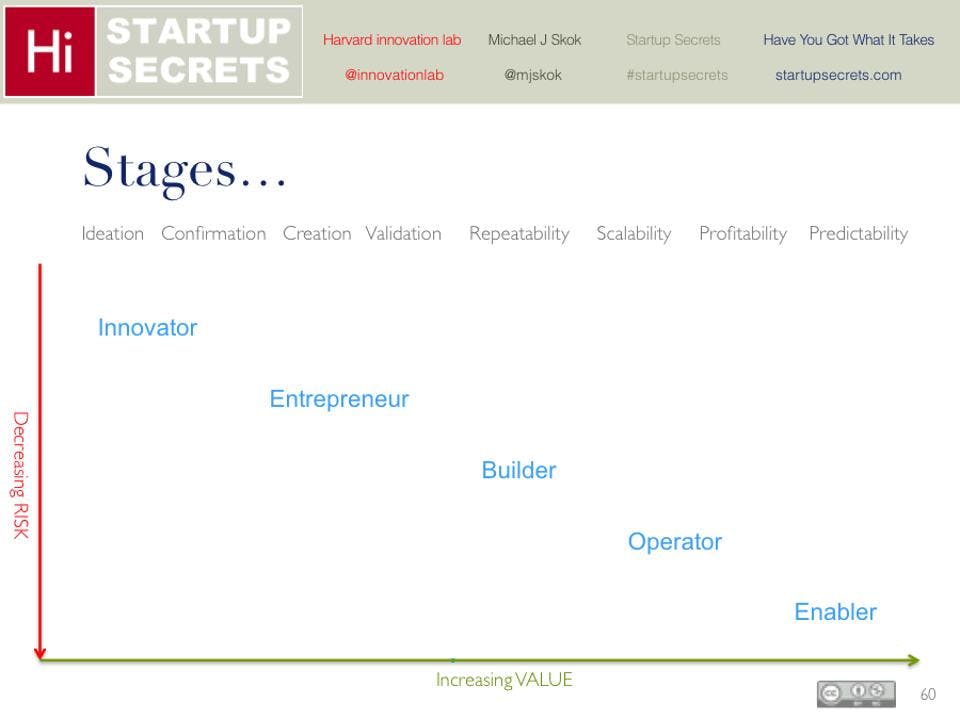
Let’s use a graphic to explain what we mean.
This graphic simply illustrates the classic stages that startup businesses often go through – from ideation all the way through predictability while their value increases over time and with good management risk is reduced. We can then plot the different roles that a CEO plays during those stages. (An obvious disclaimer. This graphic looks neat, organized and linear. In reality it’s much messier, with overlap between many of these stages and skills as well as iteration along the way. In my workshops I’m quick to point that out, and use examples beyond the scope of this article to illustrate that).
Skill Sets of a Founder
The best early-stage founders, for example, are born Innovators who excel at generating ideas and testing them. As product-market fit comes into play the role evolves to being that of an Entrepreneur engaging customers and partners to gain proof. Entrepreneurial skills can apply throughout, though as the company’s business model evolves, and repeatability of revenue and systems becomes a premium, CEOs need to think and act more like Builders. Foundational blocks of distinct value need to shape and support the business for growth. Eventually, as the business creates opportunities to scale, a CEO should begin to adopt the mindset of an Operator. Operators often formalize systems to ensure everyone understands their measures for success and provide predictable access to resources to scale predictably. And finally, as the company begins to truly breakthrough to a point where it is earning stable profits and growth, the best CEOs function as Enablers where their focus is more on empowering their organization to consistently beat expectations - for example as a public company.
This is a very large RANGE of skills that may need to be developed at a rapid pace in high-growth situations. Furthermore, it isn’t as simple as it sounds, because in reality these skills are often needed in combination.
Yet, many of these skills are also at odds. For example: being an Innovator and finding ways to make breakthroughs requires a willingness to break with routine, whereas Operators need to build routine into processes that can be relied upon.
Learning to Scale
So, it can be tough for founders to learn to scale as CEOs and to evolve along with the needs of the position without feeling like they are giving up their very identity. There are many stories of people, like Sandy Lerner the co-founder of Cisco, who appear to have felt threatened by the evolution needed rather than supported through it.
But founders clearly do need to change their role to scale. It’s not realistic to know everyone in the company intimately and have your fingerprints on every decision made. Evolving to a point where you will often feel removed from the day-to-day action at the front lines of the business is hard. All founders have to develop their own unique approach to it, but regardless it’s a tough transition for many innovators and entrepreneurs to make. Yet, in many instances, the role of a founder is supremely important to ongoing value creation. So it should not be looked at as a transition OUT but as a transition UP. And title should be irrelevant. Three good examples from my Harvard iLab class on “ Have You Got What It Takes
” would be Gail Goodman, and in full disclosure in our portfolio, Stephan Schambach and Jon Hirschtick.
Demandware: Stephan Schambach
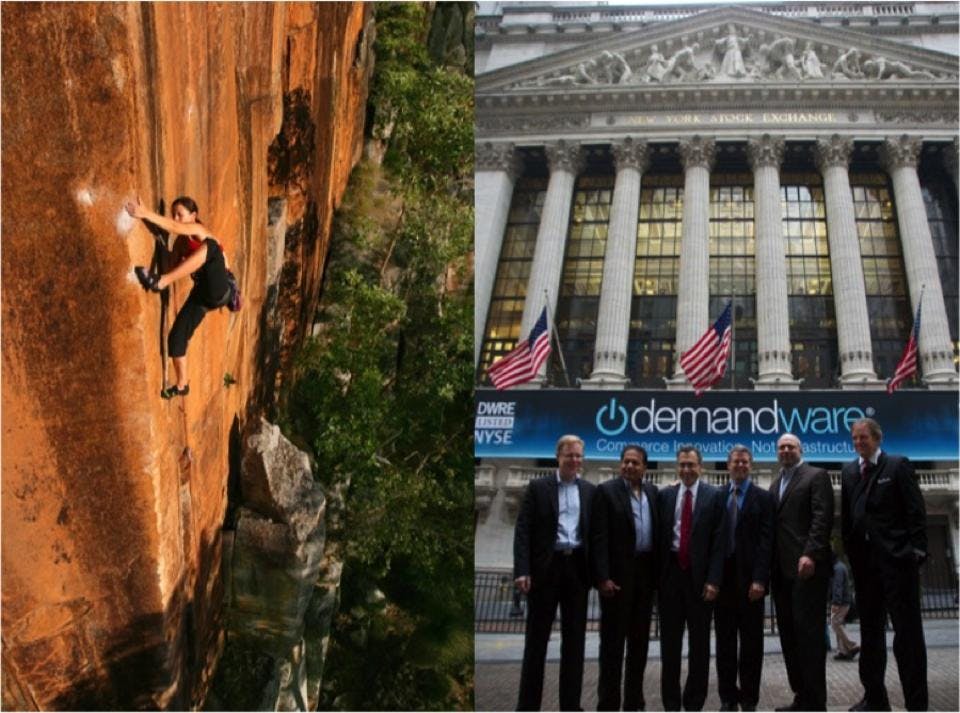
Stephan Schambach is the founder of Demandware , now a multi-billion dollar valued cloud commerce leader that last year alone, handled approximately 150M registered shoppers and processed over 80M orders––covering more than a quarter of a billion items sold and billions more dollars in transactions. Stephan co-founded and built the company from ground up into a leading commerce provider in the retail industry and has steered Demandware with great vision. Today, he continues to add tremendous perspective as an active board member and has a strong executive team managing the business day-to-day and taking the company to the next level.
Solidworks: Jon Hirschtick
Jon Hirschtick founded SolidWorks in 1993, with the goal of building 3D CAD software that was easy-to-use, affordable, and available on the Windows desktop. Today, the company has sold billions of dollars worth of CAD/CAM software and continues as part of Dassault Systemes, a company that acquired SolidWorks in 1997. Several years after the acquisition, Jon transitioned out of the CEO role and promoted his long-term partner in building SolidWorks and a great business leader, John McEleney, as CEO after achieving a run rate of $100M in revenue in 2001. In 2011, Jon Hirschtick decided to leave SolidWorks to begin the next phase of his career founding another equally high-potential company, OnShape. Not surprisingly, he brought John McEleney with him as a partner from day one. This is a story of thoughtful partnership that has endured and is repeating success.
Constant Contact: Gail Goodman
And just because it’s tough, doesn’t mean that every founder will fail to scale UP – especially if they are willing to acknowledge the harsh truths about what is actually holding back their personal development. Case in point: under CEO Gail Goodman’s leadership, Constant Contact , which provides online marketing services to small businesses and has grown to some $285 million in annual revenue since it was founded in 1998.
Gail has been at the helm of her company for all of its 15 years and running, which is no small feat. During a recent Startup Secrets session we asked her what her secret was to scaling herself at the rate that her business was growing, she shared this key piece of advice: “You have to face yourself,” she says. “You have to be unbelievably ruthless about what’s working and what’s not working. As CEO, you will have to change hundreds of times to face the different challenges in the different stages your business will go through.”
The rub is that many founders share a common characteristic that is invaluable in a company’s early days: drive. “But being relentless in your perseverance can eventually become an obstacle to change,” says Gail.
Gail, for example, played a key role in product management when Constant Contact was in its early days. She was good at and she was comfortable in that role. Only, as the company grew, she continued to be involved in the day-to-day product decisions. It wasn’t until one of her employees, the head of engineering, took her out to lunch and confronted her with the truth – that she needed to let other people step up – that she realized she had been neglecting other critical areas the company needed her to focus on. “The single biggest investment you can make as CEO is where you spend your time,” she says, “and spending time where I was comfortable was a mistake.”
You can watch the panel discussion with Stephan, Jon and Gail below:
The point of these stories is that while it’s rare to see innovators evolve into operators, it is possible to do as Stephan, Gail and of course many other legends such as Jeff Bezos or Bill Gates show us. It means you need to be excited about the challenge of constantly changing and evolving. At the same time, there are plenty of examples of founders who have no interest in running a later stage company and there’s nothing wrong with that either. For what’s it’s worth as an investor, it really matters to me to see founders stay really engaged building the company, no matter their role or title. However, in the end, there’s no one-size-fits all strategy out there. What matters is what choice YOU, as a founder, want to make over time.
🎙 Hear how Michael taught it the lecture, cleaned & woven in
▶ Watch the original lecture
Founders Can’t Scale: Fact or Fiction?
Gail Goodman is the founder-CEO of Constant Contact. Technically she joined a small tech team when they were pre-product, pre-revenue, pre-funding, pre-just-about-everything, so not exactly the founder, but “when you run it on your credit cards, you get at least the little-f founder.” When she gave a TED talk, the theme was “founders can’t scale.” Today Constant Contact did $285 million in revenue last year, has just shy of 600,000 customers, and serves the small business market. She’s also a first-time CEO, which means for the last 12 years she’s kind of been winging it, and defying the odds.
What does scale mean? Going from the stage where you’re the team lead, you know everybody on the team and every project, and your fingerprints are all over everything, to the stage where there are people you don’t know, projects you didn’t kick off, and things you can’t be involved in because there’s so much going on. Most VCs would tell you founders rarely navigate that path, and the data backs it up. If you’re thinking about starting a startup, the data says that in three years you will no longer be the CEO. By four years that’s down to 40%. If you’re lucky enough to get to public, it’s down to about 25%. And yet you have the iconic names in your head of folks who have done it. What did that little collection of folks have in common? One thing, a little hard to replicate: brilliance. “I’m not brilliant, so I had to find a different way.”
There is a better way. It’s ridiculously simple and unbelievably hard: you have to face yourself. You have to hold up a mirror to your leadership and be willing to be unbelievably ruthless about what’s working and what’s not. As a business grows and changes, you’ll need to change not once or twice but literally hundreds of times, because the business needs different leadership at different moments. And you’ll have to face two really ugly truths. First, you’re doing something wrong all the time. Second, your flaws are actually harming the team. I put it so harshly because most founders’ success came from their relentless confidence, perseverance, and stubbornness (Gail’s single most successful characteristic), which also makes you a little less inclined to look inward.
You’re Doing Something Wrong: Where You Spend Your Time
The role you play changes. Very early on, Constant Contact was all about product-market fit: who’s the customer, what problem are we solving, can we get them to open their wallets. Gail’s career path was through product management, so she was really comfortable as the lead product manager and dug in deep. Then they got some traction, and she stayed with the product team and dug in further. One day the head of engineering invited her to lunch. She thought it would be a career chat about him, but he did one of the bravest things: “Gail, you are driving the team nuts. You need to get out of our shorts.” He was totally right. Not only was she driving that team crazy, she wasn’t spending time on their go-to-market strategy, which was where the company needed her focus. By staying where she was comfortable, she was robbing the team and doing the wrong thing.
One of the single most important investments you’ll make as a founder-CEO is where you spend your time, and yet we tend not to think about it. We’re guided by the urgent, the to-do list, the Outlook calendar, the email flow, instead of stepping back and being thoughtful about the single most important investment: where do you spend your time on the business?
Two things that helped. First, she got a CEO peer group early, her strongest recommendation to any founder. They were all tech founder-CEOs under two million in revenue, VC-backed, so they had a lot in common. They met for a day and a half every quarter (a huge investment of time that seemed crazy at first). One of the openings of each meeting: “Where did you spend your time last quarter? Where should you spend it next quarter?” It forced her to step back and see the forest for the trees, because in a startup you’re going to be in the weeds every day, intensely busy. Second, regular executive team offsites where they looked at what was going well and what was not. A flaming insight: when something’s not going well, it could probably use some of your time, and yet that wasn’t necessarily where her time was going. Critically self-grading the business and understanding their biggest challenges to the next step of growth helped guide her priorities.
Your Flaws Are Harming the Team: Feedback Is a Gift
We all have strengths and weaknesses, and by the time you get to Gail’s age you pretty much know them, having heard them three or four times, and you probably have a well-constructed self-rationalization for why your weaknesses are really strengths. Gail’s example: “I’m very impatient. It’s my impatience that’s driven this company to the next level every year, that’s my rationalization. But my impatience has a dark side for the team.” One outcome was a “get it moving” hand signal she’d use when people were presenting and not going fast enough. It was a much-hated symbol, because it said, “You put a lot of work into this, but I’m bored, move it along,” or “Your work isn’t important enough for me to listen.” It stifled conversation in the room (if the CEO is doing that, will the next person ask a question?), and worst, leaders stopped bringing their young, up-and-coming talent to present to her, because they didn’t want them to get the symbol, so she stopped getting to work with their very best people.
So you need to be aware of how your flaws harm the team and be willing to change, and the first step in awareness is knowing. Feedback is a gift. In the land of gifts, this is one most of us would rather give. As a leader, it gets really hard to get unfiltered feedback; nobody likes giving difficult feedback, and giving it to your boss even less. So you need to create a way to make sure you’re getting it. At those offsites, they used an outside facilitator whose preparatory process was to interview every member of Gail’s team (“How’s the business going? What are you worried about?”), and somewhere in there, “How’s it going with Gail?” The first time, the facilitator came in with a page and a half. Gail was unprepared, so she “did what any good person would do: I completely shot the messenger, totally yelled at her, and got angry at the team. How could they not understand that these behaviors were the necessary outcome of the stress and strain of what we were building? Then I went home and cried, and was creeped out about facing them the next day. Then I calmed down and realized I’d been given a gift. Without knowledge, you can’t change.” Now she looks forward to her feedback each year.
The secret: if you want to start a company and then grow with it, hold that mirror up to yourself, both to what you’re doing and how you do it. Be willing to change and grow, so you can show the whole world that founders actually can scale.
View the original page ↗ · note: 2 embed(s) were broken on the source site